Market News August 18, 2015

Will Millennials be ‘Perma-renters’?


This article originally appeared on Inman.com 


Several factors have kept this generation renting, but they won’t last forever


Takeaways:

  • Many believe that millennials will continue to be renters and not homeowners for various reasons.
  • The first of the millennials were not even in a position to consider buying until roughly 2008.
  • Credit has become tighter for older buyers; therefore, the recent rise in first-time buyers actually can be attributed to millennials.

There has been a lot of buzz in the news recently suggesting that millennials will forever be renters and not homeowners.

Reasons for this theory are plentiful and include amenities that apartments offer, flexibility when it comes to moving and changing jobs, and inability to afford a home given the crushing student debt load that many are carrying.

So will this be the renter generation? Let’s take a look at the data.

Millennial homeownership rates

Those who believe in the “perma-renter” theory point to U.S. Census Bureau statistics that state the homeownership rate for individuals under the age of 35 has dropped from a peak of 43.6 percent in 2004 to 34.6 percent today.

Now, I can’t deny that this is a precipitous drop, but let’s not get carried away quite yet. To start with, the first of the millennials (born in 1982) were not even in a position to consider buying until roughly 2008. That accounts for four years of college followed by two years of work.

We all know that 2008 was a terrible year to buy a home, so let’s bring it forward a little further to 2012. At that time, the ownership rate was roughly 36.7 percent. Since then, it has dropped to the current level of 34.6 percent. This drop is hardly a drastic one, but it is a drop all the same — so what happened?

Fewer urban options

As mentioned earlier, some suggest that millennials are bypassing homeownership because they prefer to remain mobile and are drawn to the bells and whistles that modern apartment living offers.

I would add to this that urban life simply appeals more to younger people than living in the suburbs; especially to those who are just starting their careers and don’t yet have a family.

But the options to buy in many cities are few and far between. Since the Great Recession, there has been a shortage of new, for-sale multifamily development, which limits the availability of urban housing for buyers.

At the same time, new apartment projects are being built at a frenetic pace. According to REIS, 240,000 apartment units are scheduled to open their doors by the end of this year, which represents a 43 percent increase compared with 2014, and well over 100,000 units above the 10-year trailing annual average.

The makeup of first-time buyers

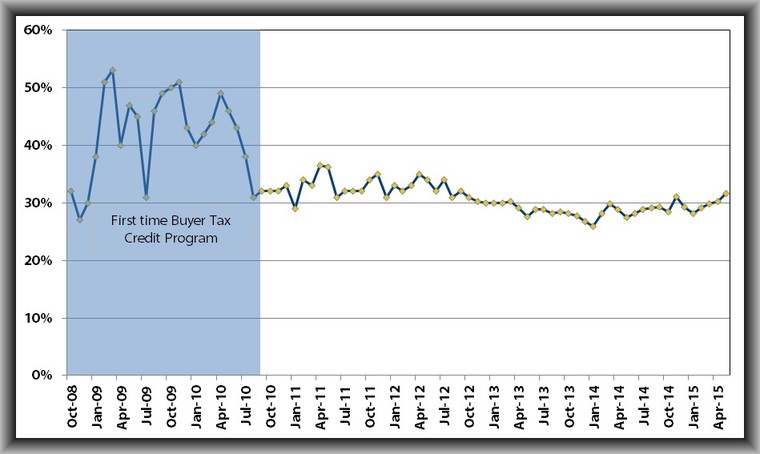
Now let’s turn to the National Association of Realtors’ data on the percentage of existing sales to first-time homebuyers. As the chart below shows, between 2008 and mid-2010, there was a rapid runup as a result of the first-time homebuyer tax credit.

After that program expired, the percentage naturally dropped and trended lower through the end of 2013. However, it’s clear that the share of sales to first-time buyers has been trending higher for the past 17 months. But not all of these buyers are millennials, so we need to dig a little deeper for answers.
Source: National Association of Realtors


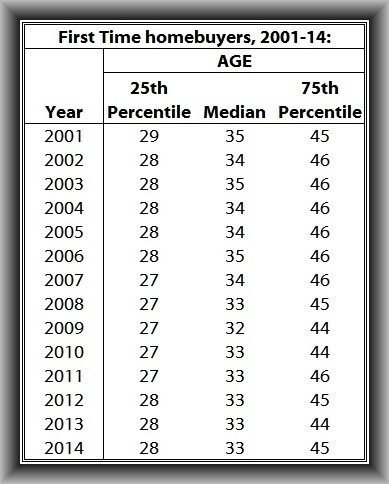
To better understand the makeup of first-time buyers, I started by looking at their age distribution. There is some great data from the Federal Reserve Bank of Atlanta that sheds light on this through analysis of mortgage data and demographic attributes.

As is shown in the table below, first-time buyers are actually not getting older. Although their numbers tumble after the crash of the housing market, the age distribution did not change drastically.

Now, if we believe that the decline was driven by the millennials, surely we would have seen first-time buyers getting older, but interestingly enough, they didn’t.
Source: Federal Reserve Bank of New York


To add to this, analysis prepared by the Center for Real Estate Analytics suggests that the gap between median credit scores of younger buyers and older buyers has closed.

In other words, credit has become tighter for older buyers; therefore, the recent rise in first-time buyers actually can be attributed to millennials.

So, if credit quality isn’t the issue holding back millennials, and rents continue to increase at a frenetic pace, it stands to reason that we will see more and more members of this generation becoming homeowners.

I hope I’ve demonstrated that these broad statements that people are making about millennials being perma-renters are unfounded.

Are many of them delaying their purchasing decisions? It appears so, but I expect them to move into homeownership in greater numbers as they start to marry, have families or simply find themselves paying too much in rent.

So where are these millennials going to buy? I’ll tackle that topic in an upcoming post.

 

Matthew Gardner is the chief economist for Windermere Real Estate. He is the former principal of Gardner Economics and has over 25 years of professional experience both in the U.S. and U.K. Follow him on Twitter @windermere.


 

More August 17, 2015

You Found Your Dream Home, Now What?

More August 14, 2015

#YourStoryIsOurStory: A Unique Challenge

Every family has unique needs to fulfill when searching for their forever home. But 3,000 action figures is more unique than most. See how the Stevens family, and Windermere agent Marguerite Giguere, found the perfect home.

Throughout the year we will be posting some of our favorite #YourStoryIsOurStory videos, photos, and blog posts. Please take a minute to share your experiences, and follow #YourStoryIsOurStory on our blogFacebookTwitterInstagramYouTube, and Pinterest pages.


More August 10, 2015

August Perspectives

Every year there’s some aspect of the real estate market that becomes a focal point for the media. A few years ago it was whether or not housing would ever recover from the Great Recession. Then it was historically low interest rates and inventory levels. And more recently, it’s whether or not this hyper-paced, multiple-offer real estate market is heading towards another housing bubble. To explore this further, we’d like to introduce Windermere’s new Chief Economist, Matthew Gardner, who doesn’t believe there’s a cause for concern, for now.


I’m often asked if we are on the verge of another “bubble” bursting due to an overheated housing market. My response is no, and here are the reasons why:

Fewer flippers: Foreclosures are the preferred property type for home flippers because they offer significantly higher margins. But with the continued drop in foreclosures, we’ve seen a marked slowdown in flipping. Nationally, the percentage of flipped homes has decreased from 6.7% in 2014 to 4% today, and this share is expected to keep declining, signifying a more normalized market.

Lending standards remain stringent: Banks actually learned a lesson from the collapse of the housing market and have made qualifying for a mortgage quite difficult. Even low down payment programs like FHA, that have less stringent FICO requirements, have significantly tightened their standards, thus lowering the risk of lending to borrowers who cannot handle their mortgage obligations.

Home prices are up, but not to pre-bubble levels: Data provided by the S&P/CaseShiller Home Price Indices tells us that in the Seattle area, the bursting of the housing bubble led to a 33 percent drop in the index. The index has certainly recovered significantly, but is still 7% below the prior peak.

Interest rates will (eventually) rise: Some fear that rising rates will take some steam out of the market, but growth in employment, and the subsequent drop in the unemployment rate, will lead to wage growth and increasing incomes, which will take some of the sting out of any rate increase.

As you can see, the housing market and economic climate of today are very different from the conditions that led to the housing bubble in 2007. Nobody can predict what’s going to happen with 100% certainty, but given the current state of things, I don’t believe there is a risk of history repeating itself in the foreseeable future. 


Matthew Gardner is the Chief Economist for Windermere Real Estate, specializing in residential market analysis, commercial/industrial market analysis, financial analysis, and land use and regional economics. He is the former Principal of Gardner Economics, and has over 25 years of professional experience both in the U.S. and U.K. 

More July 31, 2015

August Maintenance Guide

This article originally appeared on Porch.com

Written by Anne Reagan


August is a great month to enjoy the last part of summer. Days are hot, flowers are in bloom, and many people choose August as the perfect month to leave on one last summer holiday before the busy fall begins. If you enjoy working in the garden, you’ll find that August is a great time of year to harvest fruits and vegetables, trim back foliage and tend the soil. Watering may be occupying much of your time. You’ll want to read our tips about water conservation and ways to save water in the yard. If you have a swimming pool in your yard, or live near a body of water, be sure all of your guests know swimming safety basics. Sadly, children have a high rate of drowning or injuries related to swimming, and many of these incidents can be preventable. Read our swimming safety tips here.

Inside the home you might find it to be a good time to get organized before the fall. Cleaning out closets, donating unused items, and really cleaning under the bed can be a great way to get a handle on clutter. You might also want to make a “honey do” list of all the things around the home you haven’t had time to do. Hanging pictures, fixing a dripping faucet (watch our how-to video here), purchasing new water filters for the refrigerator….the list can sometime feel long. Take the time to find professionals in your area that can help you get these tasks done before the weather turns and days feel shorter. This is also a great time of year to book your winter-related professionals now like chimney sweeps, attic insulation specialists and tree trimmers. Put them on the calendar now and you’ll start the fall season feeling organized.


Here are some other tasks you can do this month:

Exterior

  • Check roof and replace loose/missing/damaged shingles
  • Replace any missing mortar (if your home is made of brick)
  • Seal chimney to prevent small animals from entering
  • Check AC refrigerant levels. If levels are low it could indicate a leak.
  • Repair cracks in your driveway/sidewalk
  • Locate & block any animal-accessible attic vents
  • Clean any mold/mildew growing on siding

Interior

  • Check/replace air conditioning filters
  • Check and replace humidifier filters
  • Turn the lead edge of fan blades downwards to push cooled air down
  • Clear out hair/other debris from sink & tub drains
  • Vacuum coils behind refrigerator

Landscaping

  • Continue to mow frequently and high to discourage weeds
  • Keep up with watering (in the morning is best)
  • Inspect your irrigation system for damaged sprinkler heads
  • Turn the compost pile and add water if necessary
  • Repair fences or gates
  • Trim trees in preparation for winter storms


 Porch.com is the free home network that connects homeowners and renters with the right home service professionals.

Market News July 29, 2015

Western Washington Real Estate Market Update


ECONOMIC OVERVIEW

Our state appears to be pretty much firing on all cylinders with annual employment growth well above 100,000 and the unemployment rate trending down toward 5%. A ll in all, it’s difficult to f ind something to worry about at the moment.

HOME SALES ACTIVITY

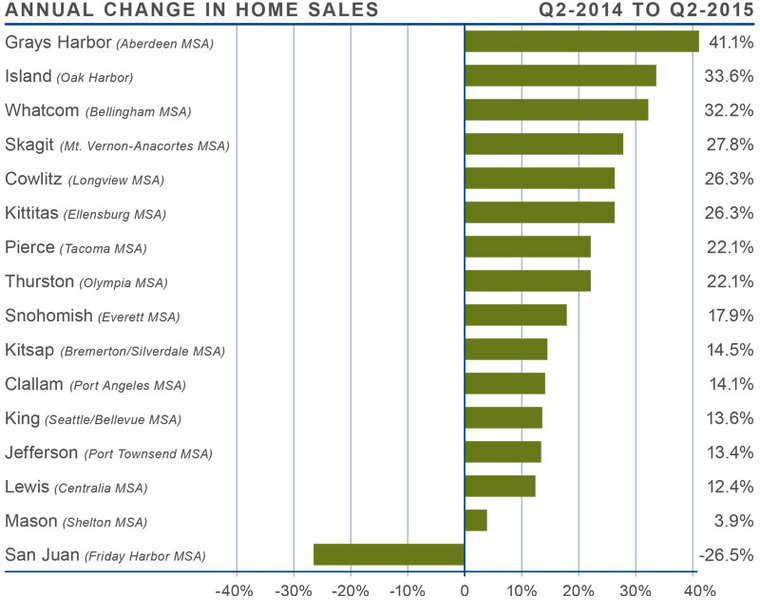
  • 21,478 home sales were reported during the second quarter of 2015, up by a substantial 17.6% when compared to the second quarter of 2014.
  • Sales slowed in the volatile San Juan County but this is no cause for concern as it reflects a drop of just 26 units.
  • The growth in sales was most pronounced in Grays Harbor County—a turnaround from the last report—and all but two counties saw double-digit percentage increases from the same period last year.
  • A bigger concern is the continued decline in listing activity which is down by almost 20


HOME PRICES

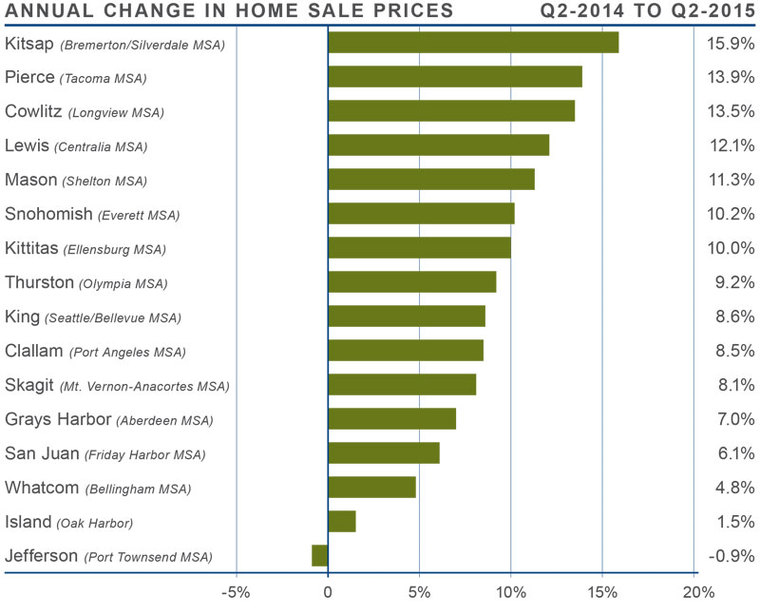
  • Prices in the region rose by an average of 8.2% year-over-year, and are 7.8% higher than seen in the first quarter of 2015.
  • When compared to the second quarter of 2014, Kitsap County showed the fastest price growth with an increase of 15.9%. Doubledigit percentage gains were also seen in six other counties.
  • For the second consecutive quarter, Island County was the only market where year-overyear home prices fell—but the difference was very minimal.
  • I still anticipate price growth continuing to increase through the balance of the year as inventory constraints persist.


DAYS ON MARKET

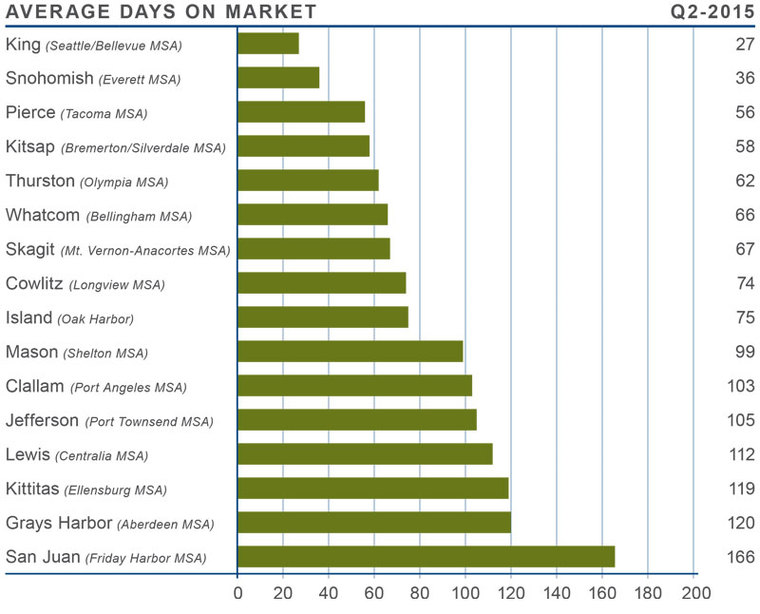
  • The average number of days it took to sell a home dropped by seven days when compared to the second quarter of 2014.
  • It took an average of 84 days to sell a home in the second quarter of this year—down from 102 in the first quarter.
  • There were just three markets where the length of time it took to sell a home did rise, but the increase was minimal and ranged from one to five days.
  • Unsurprisingly, the average time it took to sell a house in King County dropped below one month to 27 days.


CONCLUSIONS

This speedometer reflects the state of the region’s housing market using housing inventory, price gains, sales velocities, interest rates, and larger economics factors. I have moved the needle a little farther in favor of seller. In as much as we have seen some improvement in the number of homes for sale over the past few months, the stock of homes for sale is still woefully low, and demand far exceeds supply.

I anticipate that we will continue to see price appreciation continue through this year at above average rates. The big question remains as to when we will see any significant increase in mortgage rates. Given current events in Europe, our mortgage markets will be looking east for direction, rather than concentrating on domestic economic data. As such, I don’t expect a rapid interest rate growth in the near-term.

In summary, the region’s housing market remains tight with little sign that we will see any significant increase in much-needed listings. This, combined with rising home prices, has some concerned that we could be heading towards another housing bubble, but the real estate market and economic climate of today are very different to those that led to the bubble in 2007. Nobody can predict what’s going to happen with 100% certainty, but given the current state of things, I don’t believe there is a risk of history repeating itself in the foreseeable future.


Matthew Gardner is the Chief Economist for Windermere Real Estate, specializing in residential market analysis, commercial/industrial market analysis, financial analysis, and land use and regional economics. He is the former Principal of Gardner Economics, and has over 25 years of professional experience both in the U.S. and U.K. 

More July 27, 2015

Are You Ready to Buy Your First Home?

More July 24, 2015

Windermere Foundation Quarterly Report Q2 2015

The year seems to be flying by… can you believe we are already more than halfway through 2015? And what a year it has been for the Windermere Foundation. Thanks to your continued support, we have raised more than $738,000 this year to support organizations that help low-income and homeless families throughout the Western U.S. Overall, that brings the total amount we have raised to date to $29.5 million!

This past quarter, donations from real estate sales/transactions made up 40 percent of the total revenue, with the other 60 percent coming from personal donations made by Windermere agents, owners, staff, and our community partners. We are getting close to our $30 million end-of-year goal for 2015, but we still need your help to get us there!

Over the past year, the Windermere Foundation has been able to provide grants to organizations, such as Multi-Communities (M.I.C.), which provides services to families surviving domestic violence, and Mary’s Place, a drop-in day shelter for women with children.


“I wanted to extend my sincere appreciation for the funding assistance. Funding included the Community Garden of Peace Project I for young mothers ages 14-18, as well as the Community Peace Project II, in addition to rental assistance for abused moms and their children, food cards, and financial assistance for toys, books, and other gifts during the holidays. Thanks to Windermere, we were able to provide services and other assistance directly to families, in addition to helping us work towards expanding our outreach and services to multiple youth and family services organizations throughout Seattle—a gift that just keeps on giving! Thus far, we have helped 17 families.”

–Bettie J. Williams-Watson, Founder/Executive Director, Multi-Communities (M.I.C.)


“Wow! You are just love. You fill our hearts and our shelter with healing and hope! Thank for being the grace and goodness we need to survive until we get our forever homes. We love Windermere!”

— Marty Hartman, Executive Director, Mary’s Place 


These are just a couple of organizations that have received assistance through the Windermere Foundation. If you’d like to help us reach our fundraising goal of $30 million by end of year, please click on the Donate button.

Thank you to everyone who supports the Windermere Foundation. Your generosity is truly making a difference in the lives of many families in our local communities.

To learn more about the Windermere Foundation, visit http://www.windermere.com/foundation

More July 22, 2015

6 Powerful Reasons to Consider a Short Sale Instead of Foreclosure

If you are unable to make your mortgage payments, you may be considering what to do next. One option is a short sale. Another option is foreclosure. There are many benefits to choosing a short sale over foreclosure.

Before you make a decision, make sure you know the facts. Our partner, Lambros Politis, Lead Counsel and debt settlement specialist at Ark Law Group, points out six powerful reasons to consider a short sale instead of foreclosure:

Selling your home can be a tough choice. It’s an emotion-packed decision that affects your whole family. Often homeowners feel that selling short is a catastrophe – even when it’s almost impossible to make their mortgage payments.

short sale can be the first step to a financial freedom. The relief from getting out from under an unaffordable mortgage can be exhilarating. It really is the beginning of a new life.

Foreclosure is a far worse alternative to a short sale. If you keep hoping something will change – you’ll get a windfall or a huge raise – and it doesn’t happen, at some point you’ll have to stop paying your mortgage. When you go into default, your bank will foreclose. And that’s very bad news.

If your mortgage payments are too much for you to handle and you’re at risk of losing your home, I want you to consider these reasons for choosing a short sale.

1.In a short sale, all debts will be settled or re-negotiated.

With a foreclosure, your home will almost certainly sell for less than what you owe. Your mortgage lender then might have the right to sue you for the rest of the debt or garnish your wages to get the money you still owe. The nightmare isn’t always over just because you lost your property.

Washington State allows non-judicial foreclosure on a lien. If your lender chooses non-judicial foreclosure, they can’t collect any remaining balance from you after they auction off your home. However, if you have other liens against your property – a second mortgage, a HELOC, or other debts secured by your home – those lenders still have the right to sue you, garnish your income or take money out of your bank account.

With a short sale, we will work with your mortgage holder to get a deficiency waiver, so the balance of your debt is forgiven. We will also work with any other lender to remove their lien from the property. This has to happen or the short sale can’t proceed. Our negotiator will also try to get a better deal for you, if the lender won’t forgive the debt – such as a reduced payment plan.

As a rule, we’re able to get full settlements for 90% to 95% of our clients while negotiating a short sale.

2.Foreclosure has a bigger impact on your credit than a short sale.

If you stop making payments on your home, that’s a big deal to lenders. That’s why a foreclosure is noted in your credit report for seven years. Even if you recover financially, have a down payment saved and great income, you’re very unlikely to be able to buy a new home for at least a few years.

A short sale is also kept in your credit record for seven years – and will also lower your credit score. Following a short sale, the waiting period before you can qualify for a Fannie Mae or Freddie Mac loan is much shorter than if you go through foreclosure. And without delinquent payments, your credit score will be higher. If you’re hoping to get an FHA loan, you may qualify for consideration even sooner.

3.Foreclosure is public information.

There is some stigma to foreclosure. If the bank plans to auction off your home, they’ll put notices on your door and in your yard. Your neighbors will know you aren’t able to make your mortgage payments.

From the outside, a short sale looks like any other real estate transaction. No one needs to know. You’re in good company. As recently as March 2015, 10% of all home sales were short sales.

4.With a short sale, you may qualify for generous government cash incentives to help with relocation.

If you meet HAFA (Home Affordable Foreclosure Alternatives) requirements you may get up to $10,000 when your short sale closes. While it’s called “relocation assistance,” you can use the money for anything. To qualify, you need to be using this home as your primary residence.

Even if you don’t qualify for HAFA relocation assistance, you have other options. If you have a Fannie Mae loan, you may qualify for up to $3,000 in assistance at closing. FHA and VA lenders may offer $1,500.

Not all lenders participate in these programs. We find that our clients get this assistance in about 70% of the sales we help with.

5.You don’t have to go it alone.

When you work with a team of professionals, you know that you have smart people on your side, working to get you everything you’re eligible for. You don’t have to talk to your lender yourself – we’ll take care of it. Nothing falls through the cracks. You don’t have to be the expert. All your questions are answered.

In the end, it’s always better to know you did everything possible to get the best outcome.

6.After a short sale, you can start fresh.

This is what people tell me is the biggest benefit of a short sale. It comes back to what I said at the beginning. A foreclosure only gets rid of your mortgage payment. Other lenders will still need to be paid.

We work very hard to resolve ALL your debts when we negotiate your short sale. You can let go of that stress and move forward with the rest of your life.


Richard Eastern is a Windermere broker in Bellevue, WA and co-founder of Washington Property Solutions, a short sales negotiating company. Since 2003 he has helped more than 900 homeowners sell their homes. A Bellevue native and a University of Washington grad, Richard is an avid sports fan and a devoted Little League and basketball coach. You can learn more about Richard here or at www.washortsales.com.

 

More July 20, 2015

#YourStoryIsOurStory


Life happens fast. New job, new baby, a new adventure. Whatever that next step is, your agent’s job is to help you find a home that fits. A place to create new memories, tell old stories – start the next chapter.

YOUR STORY IS OUR STORY

We want to hear your stories. Like the moment you and your agent found your perfect home, the way you felt when you were handed the keys, or when your home sold and you knew you could finally move onto whatever life has in store for you next. You and your real estate agent are on a journey together, and we would love to hear about what makes that work.

Over the next year, we will be collecting videos, photos, essays, and more. Tag your tweets, Instagram photos, and vine videos with #YourStoryIsOurStory, or upload your photos with captions directly to the gallery page.  If you would like to share a video, or post to our blog, contact us in the comments. We aren’t looking for agent testimonials or reviews; rather, we want to hear about your unique buying or selling journey and how your agent helped you get there.

Throughout the year we will be posting some of our favorite #YourStoryIsOurStory videos, photos, and blog posts. Please take a minute to share your experiences, and follow #YourStoryIsOurStory on our blog, Facebook, Twitter, Instagram, YouTube, and Pinterest pages.