When you love your home but want to make some changes, how do you know where to begin? As a real estate broker and advisor to my clients, I am often asked what improvement projects are most worthwhile or where money is best invested.
In today’s market, I am consistently seeing that buyers are looking for the “cream puff” listings. They want a home that is well maintained, “move in” ready, priced well, and in a good location. No surprise there, right?
As I work with clients, whether they are preparing to move now or just looking to improve their home for their own enjoyment, I find a few things that consistently show rewards in the end.
Beginning with maintenance items such as roofing, siding, paint (both interior and exterior), windows, and a couple secret weapons that are often overlooked, which offer a huge impact and are more reasonably priced than you may think, are new garage doors and outdoor fixtures. Remember you never get a second chance to make a first impression!
Outdoor living areas have become all the rage by giving the homeowner an opportunity to add additional entertaining space to their home. The options here are endless depending on your budget and amount of space you have to work with, but this can be a great way to improve the function and finish of your home.
Take a minute to ask yourself, where do I spend most of my time in my home? Kitchen, kitchen, kitchen! We all love to eat and hang out in the kitchen. As a result, improvements here are always a good place to start.
Owner’s bedroom suites and bathrooms are also very popular areas for improvement. The range of options for these areas is vast based again on size and budget.
Consider replacing hard surfaces, base and trim, fixtures, and doors. Think outside the box and ask an expert for help choosing something that might set your home apart. Why use the same six-panel door that everyone has? Change it up a bit. Starting with the solid bones using neutral tones and embellishing with accessories to add a splash of color and your own flair is always a winner!
The more open, clean, and well maintained your home is, the greater your return on your investment will be. Buyers in today’s market have access to an abundance of information and have a good eye for short cuts. Work done just to “flip” a home will be called out very quickly! Always ask a professional for advice. You will find your favorite contractor or real estate professional will be more than happy to spend some time helping you make educated decisions that will meet your needs and show long term return.
When you think of your home, it likely conjures up feelings of safety, shelter, and comfort. However, accidental injuries in the home are one of the leading causes of harm to children 14 and younger. By taking certain precautions, many of these accidents can be prevented.
While supervision is the best way to keep your children safe at home, you can’t watch them every second. Childproofing, to whatever degree you are comfortable, will go a long way toward keeping your littlest loved ones safe and healthy at home.
Here are some tips to get you started.
Many accidents happen with or around water.
If you have children at home, it’s advisable to adjust your water heater to no higher than 120 degrees to prevent scalding. Furthermore, you should never leave a small child unattended in a bath tub, even for a few seconds. And be sure to safely secure doors that lead to swimming pools and hot tubs, including pet doors. When cooking or boiling water, turn pot handles in, or better yet use the back burners, to prevent little hands from pulling them off the stove.
Household chemicals can be very harmful to children.
It’s important not to keep poisonous materials under the sink, even if you have a cabinet guard in place. Keep dangerous chemicals up high and in a room that isn’t accessible to your little ones. Seemingly innocuous medicines can also be dangerous. Make sure your medicine cabinet is out of sight, mind, and reach.
Use safety latches and gates.
It’s advisable that you use safety latches on drawers, cabinets, toilets, and windows, as well as place covers on all electrical outlets. Gate off stairways and entrances to rooms, such as garages, that contain dangerous or fragile objects.
Secure furniture and other objects.
Heavy furniture, electronics, and lamps must be secured to prevent a child from pulling them over. Bookshelves and entertainment centers often come with devices that attach them to walls so that a climbing child won’t topple the furniture. The end-caps on door stoppers can be a choking hazard, so it’s advisable to remove them. Place plastic bumpers on sharp corners or edges of coffee tables, entertainment centers, and other furniture to prevent cuts and bruises.
Install a carbon monoxide detector.
The U.S. Consumer Product Safety Commission (CPSC) recommends that consumers purchase and install carbon monoxide detectors in addition to smoke alarms. Be sure to test both devices regularly and replace batteries as needed. The American Red Cross advises families to learn first aid and CPR, and to devise an emergency evacuation plan for fires and earthquakes.
Emergency contact info.
Last, but not least, in case an emergency does happen, always keep numbers for your child’s doctor, your work and cell, and other emergency contact info in an easily found place, preferably near the phone.
Accidents can and will happen, but by following a few small steps you can have peace of mind knowing that you’ve done everything you can to protect your family from harm in your home.
As you file your 2011 taxes, this is a good time to think about how you can make the most of certain tax benefits now or in your future. For example, if you became a homeowner last year, you are now eligible to take advantage of one of the smartest ways to reduce your taxes.
You can deduct your mortgage interest payments: Typically, the biggest tax advantage of home ownership is that you can deduct the interest you pay on your mortgage. That means the mortgage interest you paid during 2011 can be deducted on your 2011 tax return. As long as your mortgage loan amount is lower than the price of your home and is less than $1.1 million, it’s usually deductible unless you’re in a particularly high tax bracket.
In the early years of owning a home your mortgage payment is mostly interest, so the amount you deduct can really add up. But remember: to take advantage of this tax benefit, you must file IRS Form 1040 (Schedule A) and itemize your deductions.
Your property taxes are deductible, too: In addition to deducting your mortgage interest, you can deduct the property taxes you pay for both a first home and a vacation home. If your property taxes are held in an escrow account, be sure to deduct only the amount that has actually been paid out. Also, if you receive a local tax refund (from the state or county, for example), you’ll need to subtract the amount of the refund from your deduction.
When you buy your house, if your closing date is not on the first day of the month, you may have to pay pro-rated property taxes in addition to prepaying your mortgage interest. If you do, the extra taxes and interest are tax-deductible.
Do the math: When it comes to reducing taxes, home ownership is “the gift that keeps on giving.” Year after year, you can deduct your mortgage interest and property taxes, lowering the Federal Income Taxes you have to pay. Here’s how it works:
Essential tax-time documents: Whether you complete your taxes on your own or go to a CPA, make sure you have what you need to maximize your real-estate tax benefits.
This form indicates the “points” you or your seller paid when you purchased your home; sometimes you can deduct the full amount in the year you bought your house. You can even deduct the points your seller paid, if they don’t deduct them.
A few pointers on “points”
Known by a variety of names, including origination fees, loan discounts and broker discounts, points are the money you pay your lender as part of your closing costs. A point is equal to 1% of your mortgage. You can deduct the points for the year in which you pay them if your mortgage loan is for the house you live in most of the time. In order to qualify as a deduction, the amount you pay in points must be less than the amount of your down payment. So let’s say you make a down payment of $25,000; if you pay $24,999 or less in points to your lender, you can deduct it.
Sometimes the seller pays the points; you can deduct them, too, so long as your seller doesn’t. The points must be clearly shown in your HUD1 Settlement Statement.
Home Affordable Modification Program (HAMP)
If you benefit from Pay-for-Performance Success Payments, the payments are not taxable under HAMP.
Record of home improvements
Be sure to keep accurate records of any home improvements you make. Though not deductible, these costs are added to the value of your house when your capital gains are calculated. If you live in your house for at least two of the last five years and decide to sell, any profit you make up to $500,000 ($250,000 if you’re single) is yours—tax-free.
Moving expense records
If you moved for a new job, or because your employer changed location, you may be able to deduct some of your moving expenses.
Finance your home improvements the tax-deductible way
When you take out a first or second mortgage to buy a home, build one, or improve it, whether that means updating your kitchen, adding a new roof or undertaking an extensive remodel, the IRS calls that mortgage “home acquisition debt”—and it’s a great way to gain tax benefits while upgrading your home.
For most homeowners, the interest you pay on home acquisition debt is tax-deductible on loans up to $1 million for married couples filing jointly and $500,000 each for couples filing singly.
If you’d like to know more about the tax benefits that you, as a homeowner, are eligible for, visit www.irs.gov or consult a certified public accountant.
Windermere Real Estate is proud to partner with Gardner Economics on this analysis of the Western Washington real estate market. This report is designed to offer insight into the realities of the housing market. Numbers alone do not always give an accurate picture of local economic conditions; therefore our goal is to provide an explanation of what the statistics mean and how they impact the Western Washington housing economy. We hope that this information may assist you with making an informed real estate decision. For further information about the real estate market in your area, please contact your Windermere agent.
MACRO & REGIONAL ECONOMICS
As I look back on 2011, I do so with mixed emotions. On the positive side, Washington State’s job market made significant inroads into the job losses that were seen during the recession and, although the unemployment rate remains elevated, it is heading in the right direction.
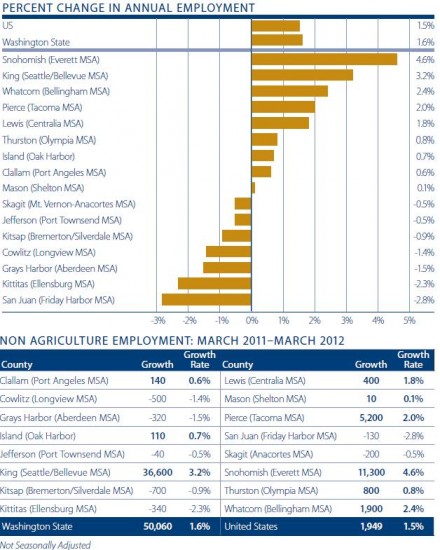
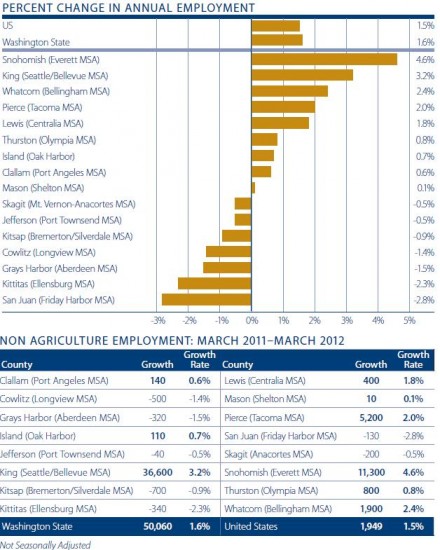
In 2011 we saw some solid job gains with the region adding 24,350 positions, representing a 1.1 percent growth rate. As the charts to the right demonstrate, the increase was seen in six counties with contraction in the other ten. That said, when I look at changes from the third quarter, even those markets that lost jobs are contracting at a slower rate, which is encouraging. Layoffs in the government sector are still acting as an anchor to growth and I do not expect this to change in 2012—even with the private sector doing its best to pick up the slack.
Six counties experienced a net increase in employment which matched that seen in the third quarter. There were few surprises here, with the major employment centers seeing the greatest increase in growth. Snohomish (2.9%), King (1.6%), and Whatcom (1.3%) Counties led the way in year-over-year growth. Job losses were most profound in Grays Harbor County (-2.3%), followed by Jefferson County (-1.9%), San Juan County (-1.7%), Mason County (-1.1%) and Kitsap County (-1.0%).
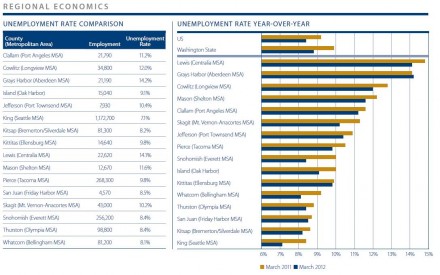
From an unemployment rate perspective, there was modest improvement over the past quarter (and past year) with five counties showing improvement, two remaining static, and nine faring worse than a year ago. Not surprisingly, the greatest improvements were found in the areas of highest job concentrations with Snohomish and King Counties leading the way. Markets where the unemployment rate grew the most were Grays Harbor, Mason, Kitsap, Jefferson and Clallam Counties.
Considering that in 2010 our market created just 1,550 jobs and in 2011 this increased to 24,350, I am going to give the current employment situation a “C+” grade, up a notch from the last quarter. My expectations for 2012 remain positive, but the headwinds that are being generated both in Washington, D.C. and Europe may affect the speed of our recovery.
REGIONAL REAL ESTATE
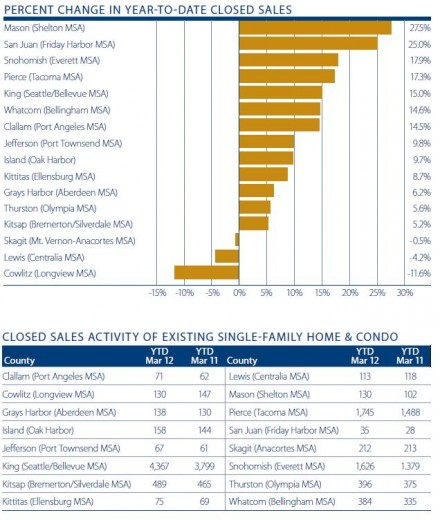
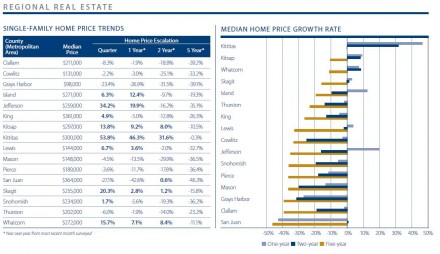
Sales transactions in 2011 demonstrated remarkable growth of 9.7 percent over 2010. When compared to 2010, we note that all but four counties saw an increase in transactions with one essentially showing no change and three showing less sales in 2011 than the prior year. The largest increases in overall sales were seen in Snohomish (+20%), Lewis (+14%), and King Counties (+12%). Declines were seen in Clallam (-9%), Thurston (-4%), and Kitsap Counties (-3.3%).
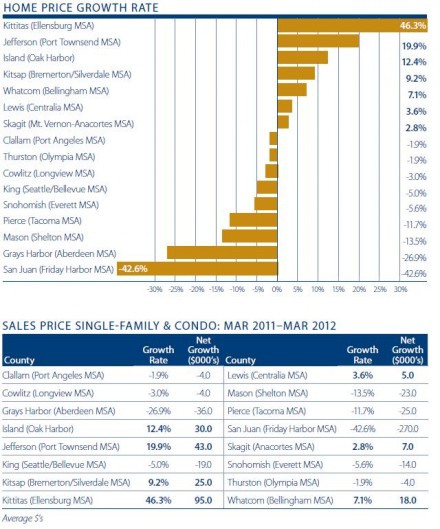
As has been the case for all of 2011, an increase in sales does not mean an increase in prices. The value of transacted units in our market declined by 15.5 percent from a year ago, excluding the volatile San Juan County which saw a drop of 14.8 percent. Looking at the specific counties within our survey, there were two that exhibited price growth from December of 2010, these being Island (+7.1%) and Clallam (+4.5%). Counties that saw the greatest price declines included: Jefferson (-30.1%), Kittitas (-28%), Mason (-26.4%), Grays Harbor (-20.5%), and San Juan (-20%).
There are, I believe, two reasons why we have not yet seen the price stability that we are all looking for. The first of these is that the sale of distressed homes continues to make up a very large percentage of all transactions and these homes sell for substantially lower than market price. In King County, for example, distressed transactions made up 40 percent of all sales in 2011. Additionally, with such low levels of supply, we have seen a pronounced change in the make-up of sales with a disproportionate percentage of homes selling in very affordable price ranges. Both of these factors are having negative effects on home prices.
I am keeping the housing market at a “C-“ grade this quarter and am unlikely to change this until we start to see more housing choices become available and the percentage of foreclosures start to decline.
CONCLUSIONS
From an economic perspective, I will not budge from my contention that Washington State represents the best of all West Coast markets from the standpoint of economic potential. The diversification in our employment base and consistent growth in private companies puts us heads-and-shoulders above our counterparts.
In as much as I certainly do not expect the state to return to its prior peak employment soon—we are still shy by 154,000 jobs at a state level and 71,000 in the Seattle area—there are tangible signs of improvement that are encouraging.
The local real estate market remains unsettled, with distressed transactions accounting for a disproportionate percentage of overall sales. It continues to be important to get these cleared before we will start to see noticeable improvement. That said, the percentage price difference between foreclosure/short sales and market rate sales is shrinking; a sure sign that value is being found in many markets.
I remain a “glass half full” analyst and believe that we will continue to see improvement in all indices in 2012.
ABOUT MATTHEW GARDNER
Mr. Gardner is a land use economist and principal with Gardner Economics and is considered by many to be one of the foremost real estate analysts in the Pacific Northwest.
In addition to managing his consulting practice, Mr. Gardner is a member of the Pacific Real Estate Institute; chairs the Board of Trustees for the Washington State Center for Real Estate Research; the Urban Land Institutes Technical Assistance Panel; and represents the Master Builders Association as an in-house economist.
He has appeared on CNN, NBC and NPR news services to discuss real estate issues, and is regularly cited in the Wall Street Journal and all local media. Mr. Gardner is also available for speaking engagements. Please call 206.442.9200 or email ge.admin@gardnereconomics.com for more information.
You may have heard rumors about a 3.8% seller real estate tax to begin in 2013 and wondered if there was any truth to it.
Simply put, these rumors are a mixture of fact and fiction: When people refer to the “Medicare Tax”, they are talking about the tax provision of the Patient Protection Affordable Care Act (PPACA), a piece of health care legislation. This provision of the legislation is an investment income tax, not a sales tax on the sale of real estate. It may mean that a small percentage of home sellers who fit very narrow parameters might pay additional taxes on the profits of home sales that exceed a designated threshold amount.
Who exactly will be affected by this tax? Only those taxpayers BOTH designated by the provision as "high earners," AND who sell their homes at a substantial profit. "High earners”, according to the new law, are those who earn $250,000 (for married couples filing jointly) or $125,000 (for couples filing separately), or $200,000 (for all others).
The tax affects only those “high earners” who will see a substantial profit from the sale of their property, but this situation is uncommon. Why is this? Profit, according to this statue, will be calculated not on the basis of sales price. Rather, it will be adjusted to reflect existing capital gains exclusions for primary residences. The existing home sale capital gains exclusion on a principal residence is $250,000 for individuals and $500,000 for couples. No “Medicare Tax” will apply to gains within these limits.
If you feel that you may be among the few who must pay this new investment tax, you may want to consider selling before the law goes into effect in 2013. It is always best to consult with an accountant and/or tax attorney before making any decisions.
Last week was a special week here at Windermere Real Estate. Close to 2,000 agents, franchise owners, and company leadership met up at the Paramount Theatre in Seattle to celebrate our company’s 40th anniversary. While we were all together, we talked a lot about milestones; where we’ve been during the past 40 years, where we are today, and where we want to be going forward. One thing that remains unchanged is the privilege we all feel to get to do the work we do – helping people find a place to call “home” is something pretty special. We also premiered a fun commemorative anniversary video which captures the pride we all feel in having reached this exciting milestone together.
Something that has been a significant part of the Windermere culture for the past 40 years is community involvement. This involvement takes many forms, but the one constant is our commitment to improving the communities where we work and live. In honor of our 40th anniversary, this year we challenged our offices to create videos that highlight the work they do in their local communities through the Windermere Foundation. We want to congratulate our three winners from Camano Island/Stanwood, Tacoma, and Walla Walla, each of whom received a $2,000 donation to their community organization of choice. These three are stellar examples of the amazing work all our agents and offices do throughout the Western U.S. You can find each complete video on our YouTube page at www.youtube.com/windermererealestate.
Thank you for allowing us to indulge for a moment in this celebration. It is because of all of you that this anniversary is possible – thank you!
This is the time of year when the most frequent question that I am asked is about home prices and which direction I expect them to move during the upcoming year.
Over the past three years, I have not made many friends, as my opinion on home prices has been quite negative. But this year, I am pleased to say that I am finding myself to be rather optimistic (well, optimistic relative to the past few years, at least).
The real estate data that I have reviewed suggests some markets are likely to exhibit positive price growth in 2012. Markets that are seeing sustained employment growth and price stability in the second half of last year are the ones most likely to see some very modest price growth this year.
In fact, I am somewhat surprised that we have not seen some price increases already. From an economic standpoint, there is a very reasonable argument that suggests that real estate prices are actually below where they should be, as they remain below the long-term trend line.
Below you will see a chart that demonstrates this theory. The blue line represents the Case-Shiller 20-City average since its inception and the red line shows where we would likely be had we not seen the real estate bubble. As the chart shows, prices are now below the long-term trend, therefore suggesting that houses may well be cheaper today than they might have been if we had never experienced the market of the past few years.
If this is actually the case, then why aren’t prices higher? Well, there are still a number of anchors that are holding us back. The first of which is the shadow inventory in the shape of distressed homes. Many foreclosures have been trading at below market value and, in some cases, below replacement cost. This naturally holds down values.
Secondly, and equally as important, are the continued issues with obtaining financing for the purchase of a new home. It remains remarkably difficult to get a mortgage, which has led to an unusually high percentage of proposed purchases falling through.
As I gaze into the crystal ball for 2012, I am hopeful that we will start to work through the excess of supply that is currently in the market at a faster pace. I am also hopeful that lenders will become less pessimistic and allow more purchases to close at the agreed-to prices.
When combined with improving economic conditions, I would not be surprised to see several markets exhibit modest price growth in 2012. That said and, as we all know, real estate is all about location; therefore I do not expect that price recovery will be equal across all markets.
In all, I remain hopeful as we enter 2012 and believe that will see several real estate markets improve in the coming year.
Later this month, Windermere agents from throughout the Western U.S. will come together in Seattle for our annual Windermere Symposium. They’ll talk about important issues, share ideas, and learn about new products and services to help them better serve their clients. It’s a time for camaraderie, collaboration, and celebration. And this year, that celebration includes kicking off Windermere’s 40th anniversary.
In honor of this exciting milestone, we thought it would be fun to look back at how things have changed during the past 40 years. In 1972, real estate looked a lot different than it does today. Instead of websites there were Polaroids. Instead of email there were hand-written notes. Real estate deals were done on the back of cocktail napkins and sealed with a handshake. And when you wanted to look at homes, you did so while riding around in the back seat of your agent’s car. Here are some other things we found interesting when looking back at the last 40 years:
Much has changed since 1972, but one thing we’re proud to say has remained the same is our agents’ steadfast commitment to their clients and their communities. They carry on the tradition started by our dad in 1972 when he founded Windermere and built a business centered on community and mutual respect. For us, Windermere’s 40th anniversary is about honoring those humble beginnings, as well as our agents who are truly the ones who make this celebration possible.
Saturday is New Year’s Eve, and the year in review articles, top ten lists of 2011, and 2012 predictions are showing up everywhere. This time of year always inspires reflection, which led us to think about some of the incredible milestones we’ve experienced over the past 12 months and what we have to look forward to in 2012.
Windermere and the University of Washington celebrate a 25 year partnership! This year was the 25th annual Windermere Cup; the international crew races that are held each year to kick off opening day on Lake Washington. The UW, Stanford University, Cambridge University, and Oklahoma University competed in this year’s regatta. The University of Washington was undefeated in both the men’s and women’s races.
More than 300 Windermere offices and 7,000 agents took the day off to give back to their communities for the 27th annual Community Service Day. Agents worked together to clean up community centers, collect and deliver baby clothing to shelters and food to food banks, and improve living spaces at domestic violence shelters.
In 2011, we pledged to “Build Better Communities, One Home Sale at a Time” with a network-wide campaign to raise awareness about the Windermere Foundation, and kids in neighborhoods with limited recreational resources. Windermere offices from Washington to Hawaii and Oregon to Arizona made a huge difference by helping to renovate local parks and recreation centers in their communities.
The Windermere Foundation raised more than one million dollars for local community organizations that provide support to low-income and homeless families. Over the last 23 years, the Foundation has raised more than 23 million dollars. A portion of every home sale or purchase made through Windermere is automatically donated to the Windermere Foundation and goes back to the communities from which the funds were raised. We’re incredibly grateful to the generosity of our agents and their support of the Windermere Foundation.
Windermere Real Estate was selected as the most respected real estate brand in the Puget Sound Business Journal survey of Washington State businesses. We were humbled by this recognition and flattered by the companies we competed with in the online “Battle of the Brands” competition. We successfully made it through four rounds, and came in a close second to Chateau Ste. Michelle.
We launched a new and improved version of Windermere.com with some great new features:
New look and feel throughout the site
Fewer clicks to valuable information and listings
More advanced-search options
myWindermere tools including saved searches, find an agent, track and share favorite listings
Listing detail pages with in-depth MLS data and research tools, such as listing history, days on market, and community details
Discover Your Neighborhood features to find information on local schools, amenities and home sales
Share listings and content via email, Facebook, and Twitter
Expanded home buyer and seller tips with integrated blog
After three challenging years, the real estate market is finally starting to see a light at the end of the tunnel with year-over-year home sales increases in most markets. While home values have continued to struggle, the lower prices combined with low interest rates have resulted in historic affordability levels.
Looking forward to 2012:
Next year marks Windermere’s 40th anniversary. To kick-off this noteworthy milestone, we are hosting a huge celebration and symposium for our agents in January. Throughout the coming year, we will also provide highlights, historical facts, and other 40th anniversary details on the Windermere Facebook page.
We are expanding our “Building Better Communities, One Home Sale at a Time” campaign so that we can have a greater impact on children and families in need throughout the Western U.S. You can learn more or donate at www.windermereandyou.org.
What were some of your favorite memories from 2011? What are you looking forward to most in 2012?
The year is nearly over, the holidays are in full swing, and reflection and resolution are top of mind. As we look back at the past year, it’s clear that in many ways 2011 was a time of transition and renewal for the residential real estate market. While recovery has been slow, the Seattle housing market has finally turned a corner, albeit a soft one with some bumps along the way. In general, sales are up, which means houses are selling, yet foreclosures and short sales continue to cause downward pressure on prices.
In 2012 we will likely see foreclosures rise, but not for the reasons you might think. Banks are beginning to focus more heavily on the backlog of foreclosures and are therefore expected to take on a higher volume of filings in the coming months. As they work through this backlog, it will appear on the surface that foreclosures are on the rise, when in reality, mortgage defaults are actually on the decline. In other words, foreclosures will continue to be prevalent in 2012, but they probably shouldn't be looked at as an indicator of the overall health of the housing market.
Amidst the ups and downs of the real estate market, one thing that kept our spirits up in 2011 was historically low interest rates. Low interest rates have the power to make homes more affordable, mortgage payments cheaper, and loan terms shorter. And because of this, home buyers and owners alike saw stellar opportunities to lower their payments or refinance during the past year. Interest rates are expected to remain low in the coming months, so as we head into 2012, there’s still time to do the math to see if it makes sense to act.
There are a lot of opinions out there about what the housing market will do in 2012, but in the absence of a crystal ball, it’s impossible to know exactly how it will fare. What we do know is that it feels like real estate is returning to its roots – where buying a home is less about red hot deals and more about long-term benefits. We’re encouraged by this shift and hope to see more of it as we usher out the old and ring in the new with a sense of reverence and optimism for what’s to come in the New Year.
From our family to yours, wishing you all things merry and bright this holiday season.