For the past 31 years, Windermere offices have closed their doors to dedicate a day of service to provide support for members of our communities and nonprofit organizations that help our neighbors in need.
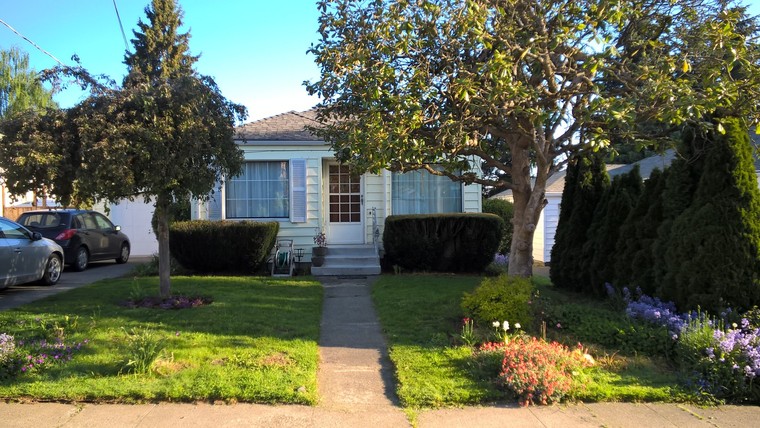
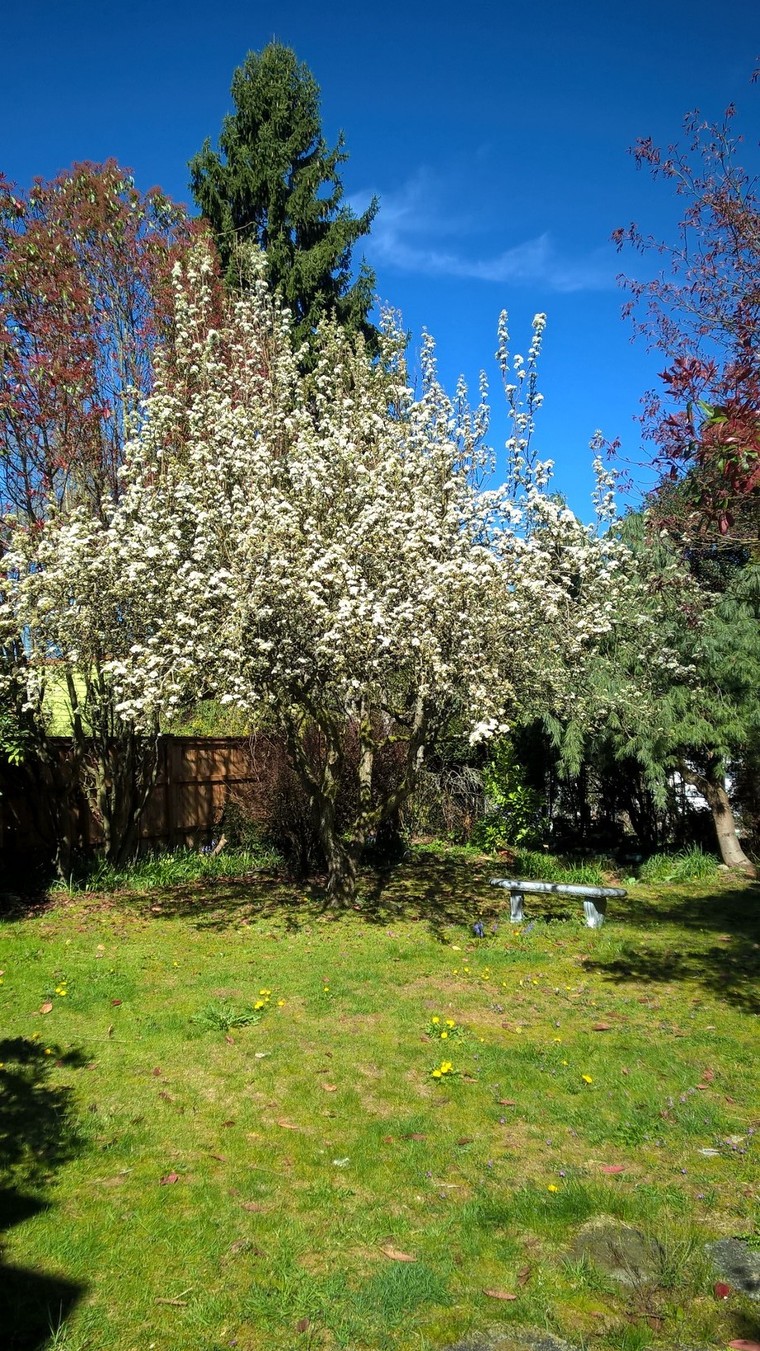
A few years ago, a group of Windermere agents and owners were hit personally when a boy in their community, Henry, was diagnosed with Birkins Lymphoma at the age of 13. This office decided to spend their Community Service Day helping to ensure Henry’s home and favorite space, his back yard, was safe for him to enjoy. And even after his passing, this space continues to provide his family a place to honor his memory.
To learn more about Community Service Day projects in your area please go here.
After losing over 134,000 jobs during the Great Recession, the Las Vegas metropolitan area has recovered all of those jobs and employment is now at an all-time high of 934,600. Year-over-year, the market added 24,600 new jobs. This is up from the annual pace of 21,300 jobs seen at the end of last year, but below the average annual rate of 32,700 seen through the whole of 2015. However, with an annual growth rate of 2.7% I see no reason to complain.
The local unemployment rate rose from 5.6% to 6.0% between February and March of this year, but this data set is not seasonally adjusted. (Seasonal adjustments remove the influences of predictable seasonal patterns to show how unemployment changes from month to month.) As such, I am not too concerned and would note that the current rate is still down substantially from the 7.2% unemployment rate that was in place a year ago.
HOME SALES ACTIVITY
Sales activity in the area rose by an impressive 7.7% when compared to the first quarter of 2015, with 7,248 home sales.
The fastest rate of growth in sales came in the North Las Vegas sub-market which rose by 11.3% to 757 home sales.
Pending sales rose across all areas, with the Sunrise sub-market showing the greatest growth when compared to the first quarter of 2015 (22.6%). This was followed by Downtown (+21.4%). Total pending sales were up by 12.9%.
Inventory remains tight with half of the sub-markets seeing modest increases in listings compared to a year ago, and half showing a decline. In total, listings are down year-over-year by 3.3%. The greatest increase in listings was seen in the South Summerlin/Lakes sub-market (+6.6%).
HOME PRICES
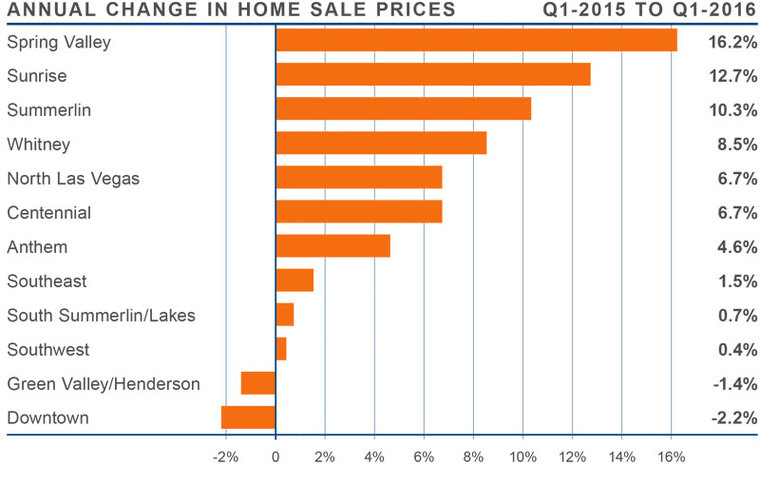
Average prices in the region rose by 4.4% year-over-year to $232,045.
All but two counties saw prices rise compared to the first quarter of 2015, and three sub-markets registered double-digit percentage gains.
Spring Valley saw the strongest annual growth with home prices rising by 16.2%.
Prices fell in the Downtown and the Green Valley/Henderson sub-markets but the declines were minimal.
DAYS ON MARKET
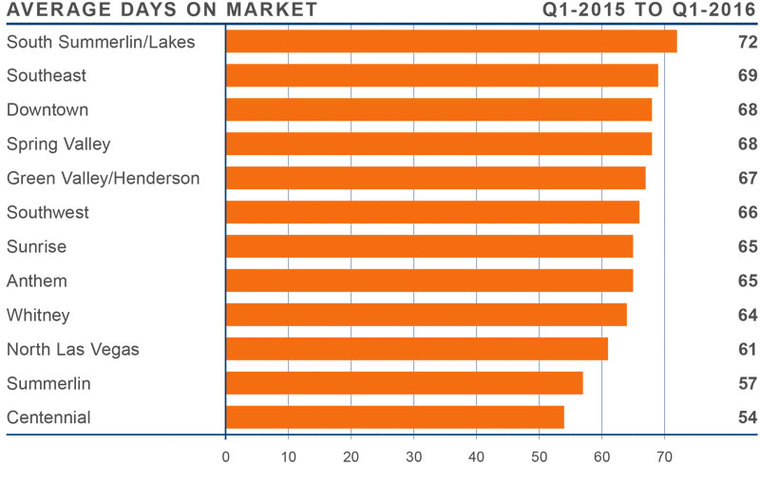
The average days it takes to sell a home in the region dropped by six days when compared to the first quarter of 2015.
The average time it took to sell a home in the region was 63 days.
The South Summerlin/Lakes sub-market was the only market where the number of days on market increased (+3).
The greatest drop in days-on-market was seen in the Southeast and Summerlin markets which both dropped by 16 days.
CONCLUSIONS
The speedometer reflects the state of the region’s housing market using housing inventory, price gains, sales velocities, interest rates and larger economics factors. The Southern Nevada economy continues to expand and I do not see this changing in the foreseeable future. There has been some modest improvement in inventory levels across the region, but many areas are still well below historic averages, causing the market to remain in favor of sellers. While prices have not yet reached their historic peak, they’re showing strong gains, thanks in part to the continued decline of distressed home sales.
Matthew Gardner is the Chief Economist for Windermere Real Estate, specializing in residential market analysis, commercial/industrial market analysis, financial analysis, and land use and regional economics. He is the former Principal of Gardner Economics, and has over 25 years of professional experience both in the U.S. and U.K.
Southern California continues to add jobs but the rate of increase has started to taper. Through the end of the first quarter of 2016, the counties that make up this report added 71,100 new jobs, and year-over-year, employment is up by 196,100 total jobs for a growth rate of 2.1%. Regional unemployment remains steady or is dropping modestly, and most counties are at or approaching full employment.
HOME SALES ACTIVITY
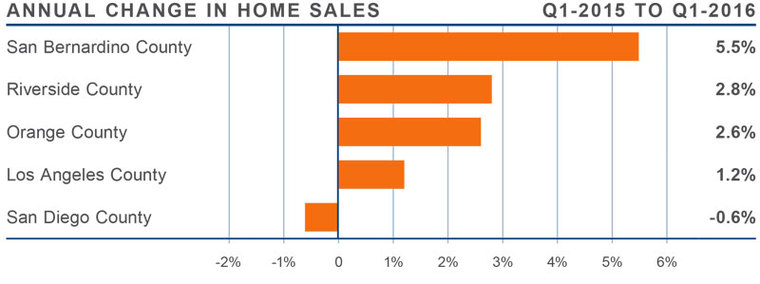
There were a total of 38,917 sales in first quarter, which is a modest increase of 1.9% compared to a year ago.
The modest increase in sales is primarily due to inventory constraints and price/affordability. Total listings were down by 5.5% in first quarter when compared to the first quarter of 2015.
Home sales grew fastest in San Bernardino County, at twice the rate of the other counties contained in this report.
San Diego County saw a modest decline in sales which is a direct result of a 9.1% decrease in active listings.
HOME PRICES
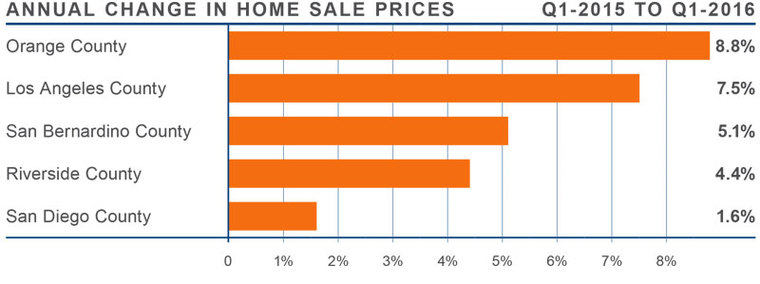
Compared to first quarter of last year, average prices in the region rose by 5.8% to $594,152. We are seeing a slowdown in price growth that can be attributed to affordability issues that are becoming prevalent in many markets.
Orange County saw the greatest appreciation in home values (+8.8%) to $767,667. This was closely followed by L.A. County where the average price rose to $747,300.
DAYS ON MARKET
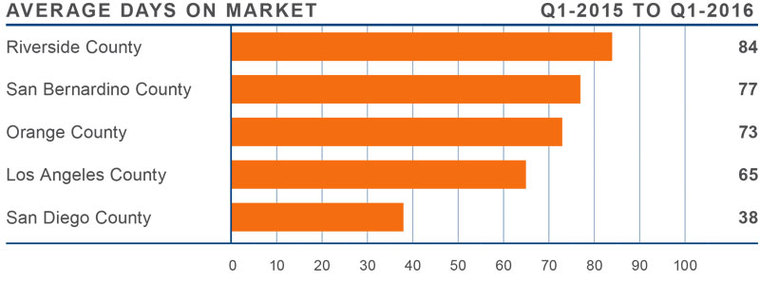
The average time it took to sell a home in the region was 56 days. This is a drop of five days when compared to the first quarter of 2015.
Homes in San Diego County sell at a faster rate than the other markets in the region. In the first quarter, it took an average of 38 days to sell a home, which is 10 days less than a year ago.
The drop in days on market can be blamed on a lack of available inventory. I am optimistic that we will see more homes for sale as we move through the year, but demand will certainly continue to outstrip supply during 2016.
All counties saw a drop in the amount of time it took to sell a home between the first quarter of 2015 and the first quarter of 2016.
CONCLUSIONS
The speedometer reflects the state of the region’s housing market using housing inventory, price gains, sales velocities, interest rates and larger economics factors. The regional economy continues to expand but the rate of growth has started to taper. Inventory constraints persist, which has been driving prices higher, but this has given rise to affordability issues which are becoming pervasive.
In the coming months, the housing market will continue to favor sellers; however, for the time being, concerns about escalating home prices should be offset somewhat by the continuation of very competitive mortgage rates. We will still see strong demand for homes, but I believe we’re going to start moving towards a more balanced market through the duration of 2016.
Matthew Gardner is the Chief Economist for Windermere Real Estate, specializing in residential market analysis, commercial/industrial market analysis, financial analysis, and land use and regional economics. He is the former Principal of Gardner Economics, and has over 25 years of professional experience both in the U.S. and U.K.
The total number of Oregonians employed in March reached 1.94 million, which was up substantially from 1.84 million in March 2015. The rapid rise in the number of employed is the main driver of an increase in Oregon’s labor force participation rate, which shot up to 62.3% in March from a recent low of 60.8% in March 2015.
Oregon’s unemployment rate dropped to a record low of 4.5% in March—the lowest point since comparable records began in 1976. Oregon’s February unemployment rate was 4.8%. A year ago, in March 2015, Oregon’s unemployment rate was 5.7%.
Rapid job growth in concert with historically low unemployment rates demonstrates to me that Oregon’s labor market is stronger than it has been in decades.
HOME SALES ACTIVITY
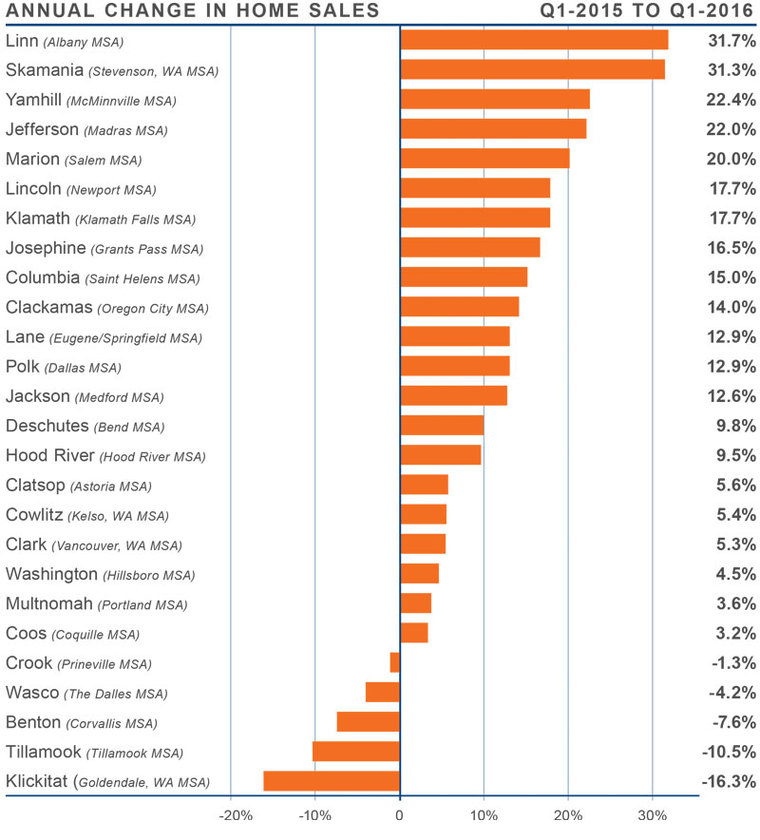
Sales activity rose by 8.8% compared to the first quarter of 2015, with 13,094 home sales.
Double-digit percentage increases in closed sales were again seen in a majority of the counties, but we did see some declines in five of the 26 counties that are contained in this report.
Sales rose the fastest in smaller counties, with Linn, Skamania, Yamhill, Jefferson and Marion Counties leading the way.
Decreases in sales activity also tend to be more prominent in smaller counties, which are prone to pronounced swings. At this point, I don’t believe any drop in sales is a function of declining demand.
HOME PRICES
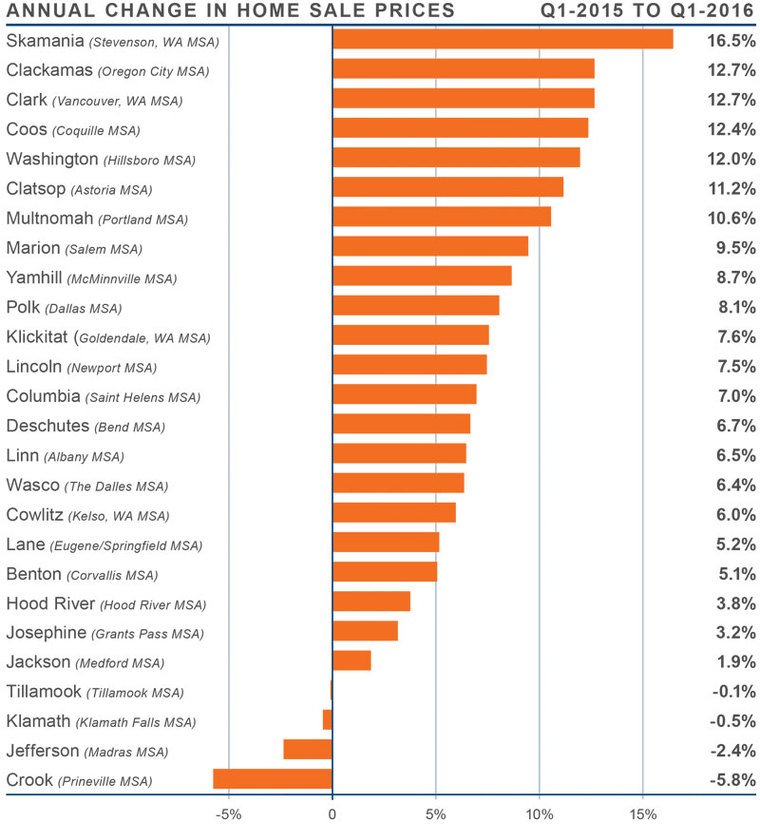
Average prices in the region rose by 9.1% year-over-year to $315,746. The modest slowdown that was discussed in the last quarter’s report did not continue but has actually reversed course and started to increase at a faster pace than seen in recent quarters.
All but four counties saw prices rise compared to the first quarter of 2015, with seven counties showing double-digit percentage gains.
When compared to first quarter of 2015, Skamania County maintains its position as the market with the strongest price growth with home prices rising by 16.5%. This remains a function of the size of the market, which allows for substantial swings in price.
Double-digit growth was seen in Clackamas, Clark, Coos, Washington, Clatsop and Multnomah Counties, demonstrating that markets close to urban centers, as well as smaller counties, can show fast price appreciation.
DAYS ON MARKET
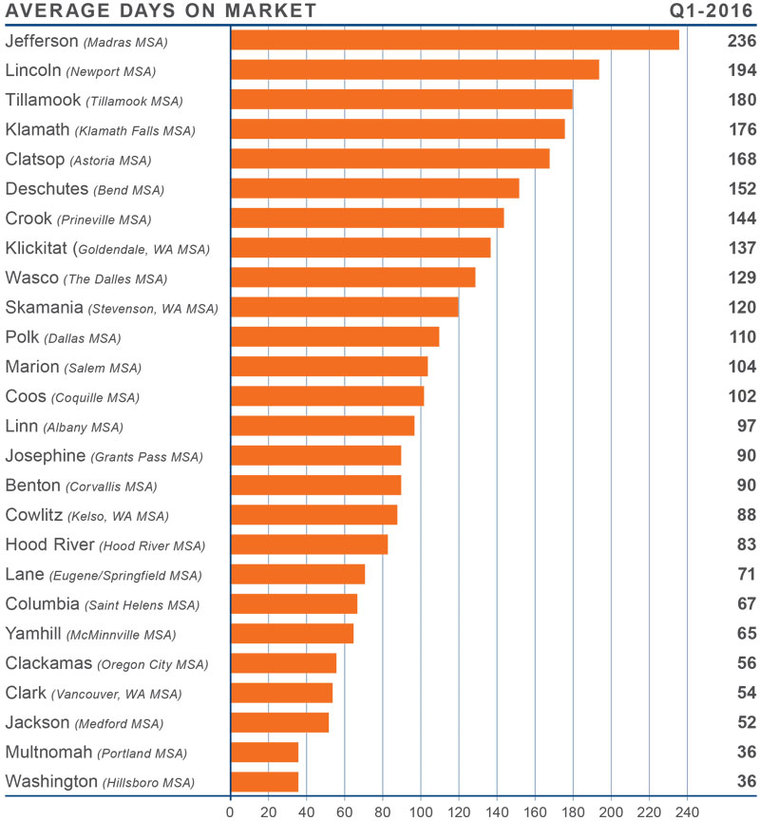
The average number of days it takes to sell a home in the region dropped by 13 days when compared to the first quarter of 2015.
The average time it took to sell a home in the region was 109 days.
Jefferson and Skamania Counties were the only markets where the average time it takes to sell a home rose, but they are remarkably small areas, so the change does not concern me at this point.
The fastest sales pace was seen in Washington and Multnomah Counties, which registered at a little over one month.
CONCLUSIONS
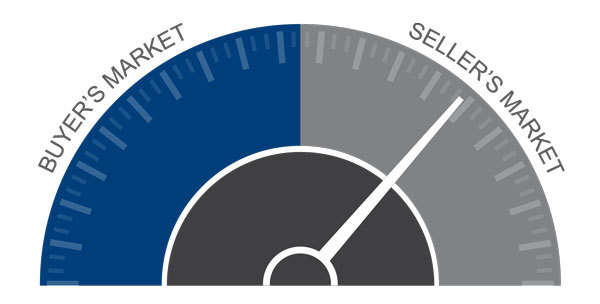
The speedometer reflects the state of the region’s housing market using housing inventory, price gains, sales velocities, interest rates and larger economics factors. Growth in the Oregon economy is impressive and unlikely to slow down in the foreseeable future. This bodes well for the housing market.
Anticipated inventory growth in the spring has yet to emerge, but I am hopeful that we will see a modest uptick in listing activity as we move toward the summer months.
Interest rates will remain at very favorable levels which will continue to encourage buyers who, unfortunately, will still have to be very patient during the home buying process. As such, I have moved the needle just a little more in favor of sellers.
Matthew Gardner is the Chief Economist for Windermere Real Estate, specializing in residential market analysis, commercial/industrial market analysis, financial analysis, and land use and regional economics. He is the former Principal of Gardner Economics, and has over 25 years of professional experience both in the U.S. and U.K.
This Saturday, May 7 marks the 30th anniversary of the Windermere Cup rowing regatta – an event held in conjunction with the Seattle Yacht Club on the Opening Day of boating season. This year is an especially exciting year as we celebrate 30 remarkable years of an event that was started by Windermere founder John Jacobi and the University of Washington, who came together to turn Seattle’s opening-day rowing regatta into something that could attract the highest caliber crews from around the world.
Over the years, countless universities and more than 20 countries have rowed in the Windermere Cup, including England, Germany, New Zealand, China, Australia – and the former Soviet Union, who raced in the event’s historic first year during what were very politically unstable times between the U.S. and USSR. Thirty years later, the Windermere Cup has invited Russia back to compete against the Husky men, bringing the event full circle.
“The very first Windermere Cup saw the former Soviet Union take on the UW in an epic matchup that would ultimately make international sporting history,” said OB Jacobi, president of Windermere Real Estate. “Bringing Russia for the 30th anniversary is as close as we can come to recreating that celebrated first race of this storied event.”
In addition to Russia, the UW men will face Stanford, while the UW Women will go up against the University of San Diego and Cambridge University.
To celebrate this year’s milestone anniversary, Windermere has released a coffee table book that tells the story of the Windermere Cup. Through insightful interviews, original documents, and breathtaking photography, the book captures the historic moments and colorful stories that have turned the Windermere Cup into an enduring, world-renowned rowing event. For more information and to purchase a copy of the Windermere Cup book, please visit http://windermerecup.withwre.com/ourstory/
We hope to see you along the shores of the Montlake Cut on Saturday, May 7 for this free, family-friendly community event. Races start at 10:20 ending with the Windermere Cup around noon, and followed by the Opening Day boat parade. There will also be food vendors, booths to purchase UW and Windermere Cup gear, as well as a bouncy house. More information can be found atwww.windermerecup.com. You can also follow us at www.facebook.com/WindermereCup and @WindermereCup.
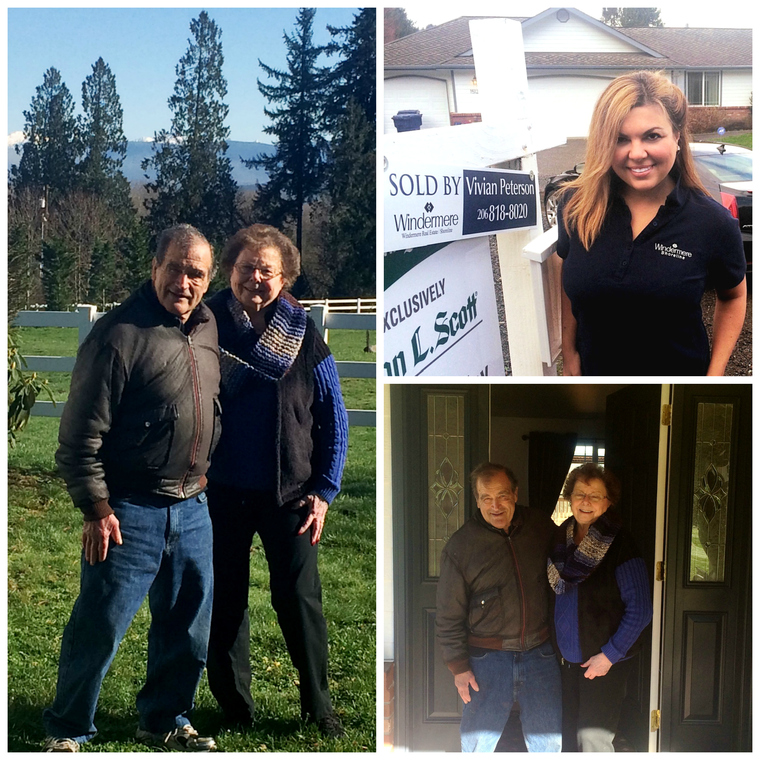
In November 2015, Windermere Real Estate agent, Vivian Peterson met some new friends that would teach her an invaluable lesson.
At an open house, Richard (76) approached Vivian about selling his current home. After almost 40 years in his place, a home he shared with his first wife until she passed away, Richard was looking to sell. This is a move uncharacteristic of Richard, but he had recently met a special woman, Virginia (74) on OK Cupid, and was looking to move to a home the two of them could share for the rest of their lives.
Vivian helped the two love birds exchange a multi-level home for a single story rambler in Monroe, accommodating her mobility needs, and in-turn made some lifelong friends. When Richard and Virginia tie the knot, Vivian is invited as a witness. In Vivian’s words, working with Richard and Virginia taught her a valuable lesson: it’s never too late to fall in love.
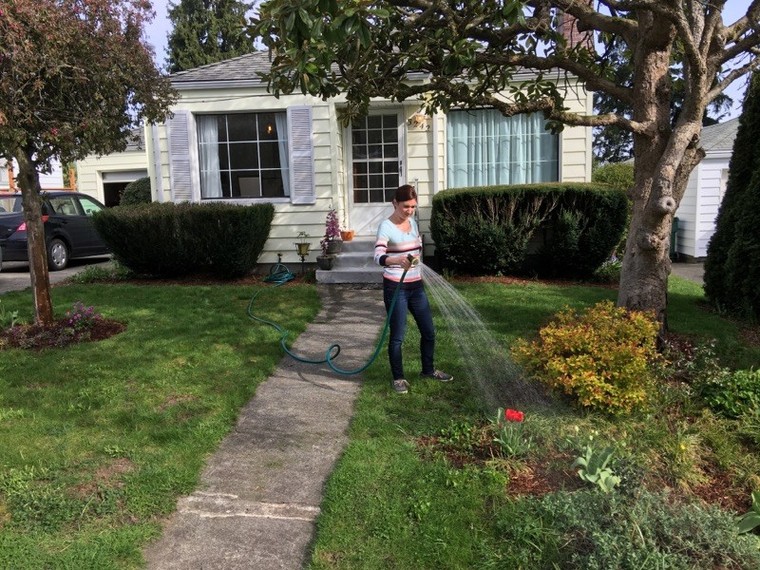
So basically, when you have a baby and wife and a career, your home reno slows down a little when your extended family flies back to their respective time zones. Last month, we shared about that pesky 15% of a project that gets left undone. And maybe we still haven’t fixed the grout line in the shower but… we did start a new project! Cleaning up the yard!
Did you know that gardening tools are really expensive? I didn’t. We even priced out what it would cost to have a landscaper come every two weeks just to mow and edge our front and back yard (which would leave us to the weeding, sweeping, etc.) but alas… that is also expensive (about $100 per month). So… Hi-ho, hi-ho, it’s off to Home Depot we go…
Seven Yard Tools All First Time Home Buyers Need:
Lawnmower: Self-propelled so you don’t have to work as hard. Just being real. Our lot is about 7,000 square feet so there’s a whole lot of other things I will do to break my back. Mowing the yard doesn’t have to make the cut (the cut… because it’s a lawn mower… get it?) $399 + gasoline (verses $150 for a bagless push mower… ain’t nobody got time for that.)
Weed-eater: Not just for trimming weeds but more for making the edges of things look more like edges rather than wobbly overgrown lines. It basically gets to the stuff your mower can’t. My dad advised we buy a gas-powered trimmer – he said they last longer and can be more powerful. A little more tricky to start though and more maintenance. I guess we could have gone either way. Who knew gardening would be such a gamble? No wonder my wife loves to garden. She also loves the casino. $119 + gasoline (Sorry, environment!)
Hose Reel: Speaking of my wife, I called Jenn from Home Depot and told her that I had found the perfect solution to our front yard hose, all coiled up on the ground. I had found a $70 hose reel/box. It was the prettiest hose box I had ever seen. My wife said that spending $70 on a plastic hose box may be a little extravagant so we met in the middle and purchased this $30 reel that seems to do the trick.
Gardening Gloves: Protective gloves are probably the cheapest thing on this list… yet we have not bought them. After paying over $100 for literal dirt to fill our raised garden boxes, I guess some luxury had to be sacrificed. $3.98/pair which is less than my typical triple shot Americano (which is a luxury I cannot part with.)
Hedge Trimmer: I haven’t used ours yet as my wife has taken up hedge trimming to express herself artistically. The previous owner of our 1940s fixer was really into her yard and planted some really cool stuff over the last 65+ years. But as she aged, the yard was less tended to and some of the larger bushes took on a life of their own. This trimmer does the trick. I recently asked Jenn to commission a topiary of our dog, Whiskey. She declined. $49.97 for a corded trimmer.
Push Broom: Good for sweeping up the big mess you make when you’re trimming stuff. I love that ours is called the “Quickie Bulldozer.” Doesn’t that just radiate power and sweeping efficiency? $9.98 well spent.
Blower/Vacuum: I experienced the thrill of my lifetime when I realized that our electric leaf blower was also a vacuum! Perfect for sucking up all the lawn clippings left behind from the weed eater. It puts that Quickie Bulldozer to shame. It’s got a max air speed of 250 MPH for $63.21. Enter manly grunt akin to Tim “The Tool Man” Taylor.
Tyler Davis Jones is a Windermere Real Estate agent in Seattle who, with his wife Jenn, recently traded in their in-city condo for a 1940s fixer-upper. Tyler and Jenn, along with the help of some very generous friends and family members, are taking on all the renovations themselves. You can follow the transformation process on the Windermere Blog or on Tyler’s websiteandInstagram.
Every quarter, the U.S. Federal Reserve releases its report regarding the Financial Accounts of the United States. Although this is a very lengthy and detailed analysis, it does contain some interesting statistics on housing. The particular “nuggets” that I look for relate to the total value of residential real estate, mortgage debt and, rather importantly, details regarding homeowner equity.
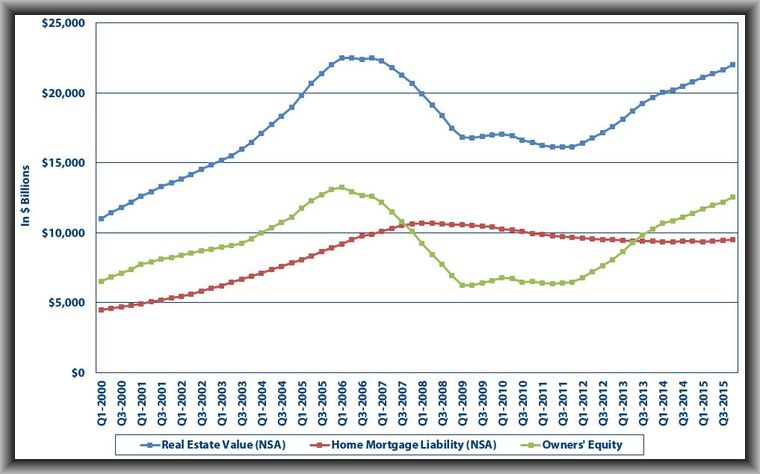
The chart below shows all of these datasets going back to 2000, and the results are rather fascinating. In regards to total real estate values, you can clearly see the pre-bubble run-up and subsequent burst that followed. From its peak figure of $22.5 trillion at the end of 2006, home values lost an enormous $6.4 trillion in value by mid-2011.
Housing Value, Equity & Debt
However, what is even more interesting is that by the end of 2015, home values had regained almost all of the value they lost in previous years, and now stand at $22.03 trillion.
A price recovery is clearly in place.
But this is not the end of the story. As much as I like to see housing values grow, if this growth is simply led by leverage (borrowing), then it is a house of cards. However, I am happy to report that this is definitely not the case here.
While home values have grown quite quickly over the past four years, we have added very little to our debt load. As the chart above shows, mortgages peaked in 2008 at around $10.7 trillion, but have since tapered to $9.49 trillion, and remain well below their historic peak.
So what does all this mean?
It means that with home prices rising and consumers not taking on additional mortgage debt, equity levels have grown substantially. The country went through a very painful period of negative equity during the housing recession, but the growth started returning in 2012, and we moved back into a period of positive equity again by the summer of 2013. In 2015, equity levels increased by an impressive 10.2 percent to $1.17 trillion. Total owner equity now stands at $12.54 trillion and is closing in on the all-time high seen in 2006.
With the appreciable gain in home owner equity levels, we have seen a rapid drop in the number of “underwater” homes, as well as an increase in so-called “equity-rich” homes (those with a loan to value ratio of less than 50 percent).
Core Logic suggests that the percentage of underwater homes has dropped to 8.5 percent at the end of 2015 – down from 25.9% in early 2010 – and according to RealtyTrac, the percentage of “equity-rich” homes has now risen to 22.5 percent. This data should ease people’s concerns regarding the formation of a housing bubble – at least a national one. Growing equity levels will certainly act as a cushion against unforeseeable drops in home values.
If this data does show one potential issue, it is that we will likely start to see more “move-up buyers” enter the housing market as they tap into regained equity and look to upsize. On the down side, this could put more buyers into an already crowded marketplace, but it may also result in a new supply of homes for sale – something that is much-needed in markets all across the U.S.
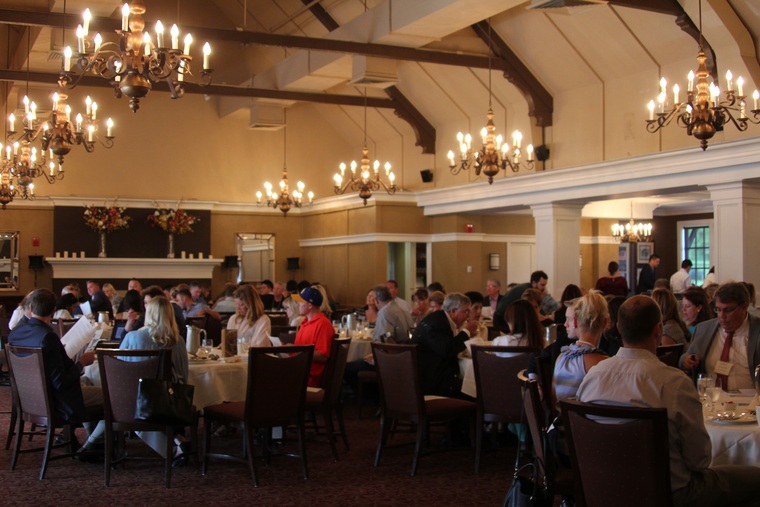
Earlier this week, at the Windermere Builder Solutions Breakfast, more than 100 Windermere brokers came together to listen to Windermere President OB Jacobi lead a panel discussion on new home construction trends in the greater Seattle area. The panelists included Mike Owen, General Manager: Macadam Floor & Design; Belinda Leppa, Sr. Designer: Macadam Floor & Design; Curtis Gelotte, Sr. Principal: Gelotte Hommas Architecture; and Eric Drivdahl, Principal: Gelotte Hommas Architecture.
Macadam Floor and Design is a new builder design center located in Kirkland and they always give us the down low on the latest trends. So, what’s in?
Bringing the outdoors inside. Do this with larger glass windows or folding glass doors.
Minerals as hardware.
Large geometric tiles on floors.
Mixing metals, such as brass and gold.
Interior paint color – Grey still has a heavy influence, but it is warming up a bit and getting softened with a stone color. Of course, the Pantone colors of the year are playing a big part with light blues and soft pinks.
Wallpaper – Always a great place to get a little crazy. Textural, geometric patterns are so in.
Carpet – 2016 is about modernizing the traditional themes. People are doing geometric shapes and soft grays. However, hardwood floors continue to be on trend. It’s not uncommon for someone to do hardwood floors throughout the whole home, others are even putting wood on the walls. Fun fact: When the economy is good, floor color tends to lighten up, and when economy is bad, floors tend to darken.
Tile– Geometry, 3D textures, and extra extra extra-large tiles. Marble counter tops are still big and concrete is becoming more common in custom homes.
Cabinets – Many are painting them white with muted tones or contrasting wood tones. Mix and match. Get venturesome, but not reckless.
Lighting – Gold has come back in (don’t worry, not the gold of the 80’s). These are different from the pendants of last year; they’re brass and gold statement pieces. Remember: lighting is the jewelry of the home.
Plumbing – Plumbing is functional art. Brass, soft gold, and black (faucet) statement pieces are where it’s at.
We also learned that home owners are going bonkers for statement dining rooms. They love having a bold, fun place to entertain their guests. These are tying into a theme, which is: Nature luxe. Like we said earlier, it’s all about bringing the outside in. Yes, we’re seeing a lot of brave ideas and statement pieces going on, but it’s important to be subtle and do it in a tasteful way.
Gelotte Hommas Architecture kept the trend going with outdoor living. Seattleites think our climate is not the greatest for outdoor spaces, but according to Gelotte, with our mild winters and not-too-hot summers, we actually have the ideal climate for outdoor living… who knew! The most important thing to know about outdoor living is that it needs to flow from the inside to the outside. The space doesn’t need to be huge; a good rule of thumb is having your outdoor space roughly the size of your kitchen.
What’s being built? Modern, contemporary homes are still very much in demand. However, contextualizing a home into a neighborhood is really important so it doesn’t stand out too much. It’s about appropriate scale and size.
Multi-gen living is on the rise. Homes are being built to accommodate extended family which usually involves having an in-law suite. Also, bonus rooms are being made into living spaces.
When it comes to thinking green, most custom home clients are concerned with energy consumption, so they opt to get solar panels or geothermal heating.
That’s a wrap for the latest trends! How are you going to incorporate them in your home?
Washington State has seen very robust growth over the past 12 months with the addition of 102,600 new jobs, which is 224,000 more jobs than seen at the previous peak in 2008. With this robust growth, it is unsurprising to see the unemployment rate trend down to 5.8%—well below the long-term average of 6.4%. As pleasing as it is to see the unemployment rate drop, it is equally pleasing to see that the decrease comes in concert with growth in the civilian labor force, which continues to grow at a very solid pace. I continue to believe that there is no risk that we will see a statewide decline in the employment picture in 2016.
HOME SALES ACTIVITY
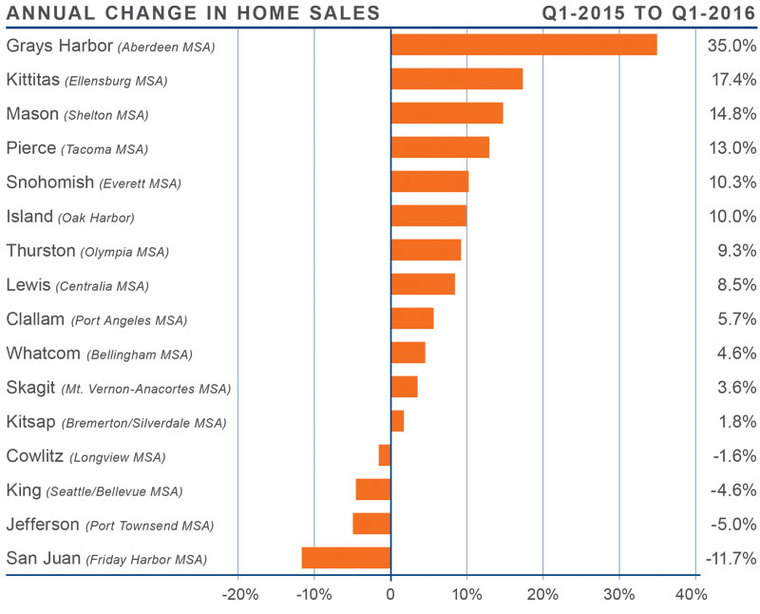
There were 13,841 home sales during the first quarter of 2016, up by 3.8% from the same period in 2015. Sales activity continues to slow as a function of inventory constraints. Any spring “bounce” in listings has, thus far, failed to materialize.
The growth in sales was most pronounced in Grays Harbor County, which increased by 35% (but represented a real increase of just 63 units). Robust increases were also seen in Kittitas, Mason, Pierce, Snohomish and Island Counties. Sales declines were seen in San Juan, Jefferson, Cowlitz and King Counties.
Overall listing activity was down by 30.1% compared to the first quarter of 2015, and this continues to put upward pressure on home prices (discussed below).
Economic vitality in the region, combined with interest rates that continue to retest historic lows, is driving buyer demand that simply cannot be met. I hope that we will see more inventory come online as we move through the year, but believe that any reasonable growth in inventory will still be insufficient for the demand in the market.
HOME PRICES
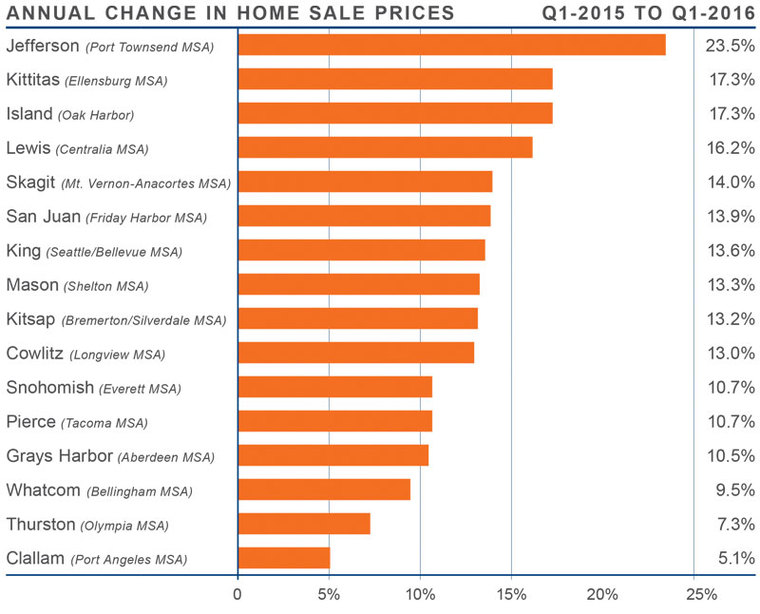
Given the demand factors mentioned above, I am not surprised that prices are up by an average of 10.1% year-over-year. This is up from the 9.3% average growth in prices that was reported in the fourth quarter 2015 report.
When compared to the first quarter of 2015, price growth was most pronounced in Jefferson County, and all but three counties saw prices increase by double digits from the previous year.
Interestingly, there were eight counties that actually saw a drop in average sale prices between the last quarter of 2015 and the first quarter of 2016. I believe this was caused by seasonal factors, but will keep an eye on it.
Very straightforward supply and demand factors are pushing prices higher. While this certainly favors sellers, I believe that there are some buyers who are starting to suffer from “buyers’ fatigue”. Rampant growth in inventory would sort this out but it is unlikely to occur this year.
DAYS ON MARKET
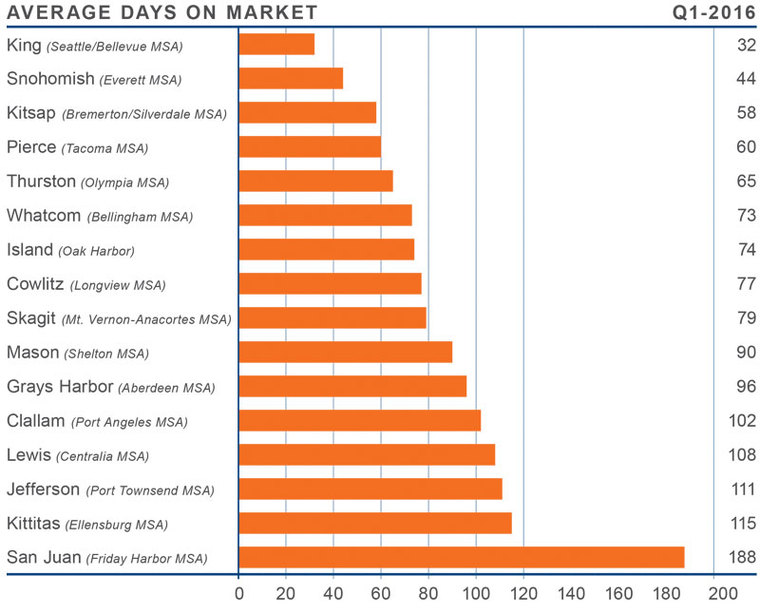
The average number of days it took to sell a home dropped by sixteen days when compared to the first quarter of 2015.
As was seen in the Q4 2015 report, there were just two markets where the length of time it took to sell a home did rise, but again the increases were minimal. Skagit County saw an increase of three days while San Juan County rose by nine days.
It took an average of 86 days to sell a home in the first quarter of this year—up from the 78 days it took to sell a home in the last quarter but this is simply due to seasonality.
Sales activity remains most brisk in the Central Puget Sound counties. Given their proximity to the major job centers, this is not a surprise.
CONCLUSIONS
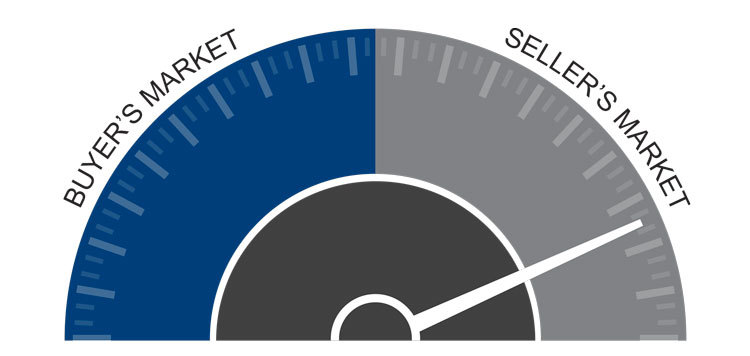
This speedometer reflects the state of the region’s housing market using housing inventory, price gains, sales velocities, interest rates, and larger economics factors. For the first quarter of 2016, I have moved the needle slightly more in favor of sellers. Inventory constraints persist and this is now starting to affect sales activity, with growth in pending as well as closed sales starting to trend down. However, price growth remains well above average and interest rates are still close to historic lows.
Matthew Gardner is the Chief Economist for Windermere Real Estate, specializing in residential market analysis, commercial/industrial market analysis, financial analysis, and land use and regional economics. He is the former Principal of Gardner Economics, and has over 25 years of professional experience both in the U.S. and U.K.

 Facebook
 X
X
 Pinterest
 Copy Link



 After losing over 134,000 jobs during the Great Recession, the Las Vegas metropolitan area has recovered all of those jobs and employment is now at an all-time high of 934,600. Year-over-year, the market added 24,600 new jobs. This is up from the annual pace of 21,300 jobs seen at the end of last year, but below the average annual rate of 32,700 seen through the whole of 2015. However, with an annual growth rate of 2.7% I see no reason to complain.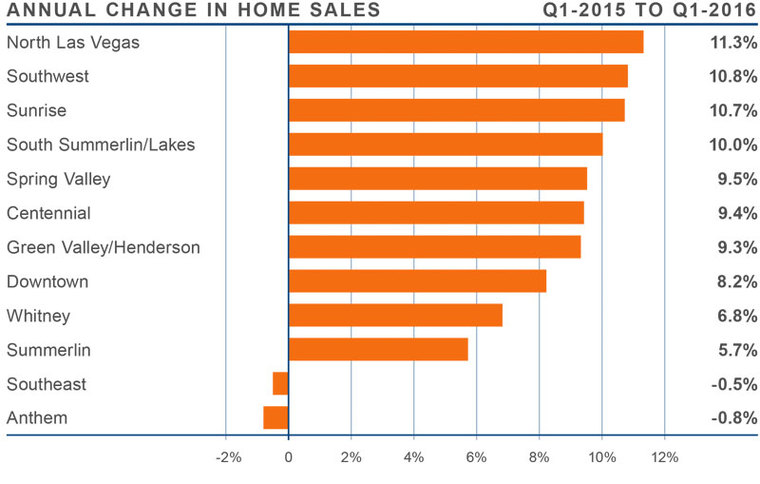
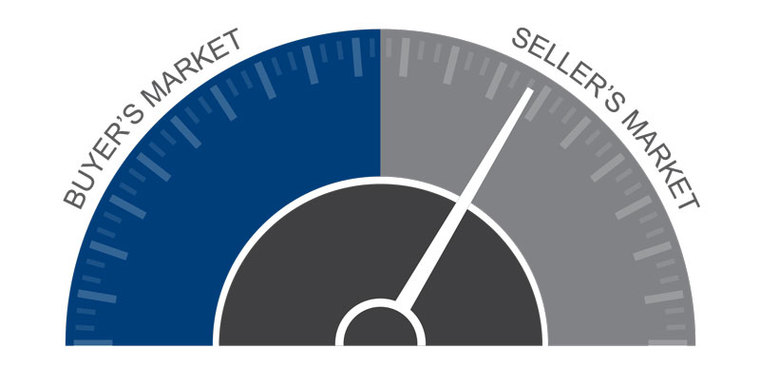 The speedometer reflects the state of the region’s housing market using housing inventory, price gains, sales velocities, interest rates and larger economics factors. The Southern Nevada economy continues to expand and I do not see this changing in the foreseeable future. There has been some modest improvement in inventory levels across the region, but many areas are still well below historic averages, causing the market to remain in favor of sellers. While prices have not yet reached their historic peak, they’re showing strong gains, thanks in part to the continued decline of distressed home sales.
 Matthew Gardner is the Chief Economist for Windermere Real Estate, specializing in residential market analysis, commercial/industrial market analysis, financial analysis, and land use and regional economics. He is the former Principal of Gardner Economics, and has over 25 years of professional experience both in the U.S. and U.K.
 The speedometer reflects the state of the region’s housing market using housing inventory, price gains, sales velocities, interest rates and larger economics factors. The regional economy continues to expand but the rate of growth has started to taper. Inventory constraints persist, which has been driving prices higher, but this has given rise to affordability issues which are becoming pervasive.
 The speedometer reflects the state of the region’s housing market using housing inventory, price gains, sales velocities, interest rates and larger economics factors. Growth in the Oregon economy is impressive and unlikely to slow down in the foreseeable future. This bodes well for the housing market.
 In addition to Russia, the UW men will face Stanford, while the UW Women will go up against the University of San Diego and Cambridge University.
 In November 2015, Windermere Real Estate agent,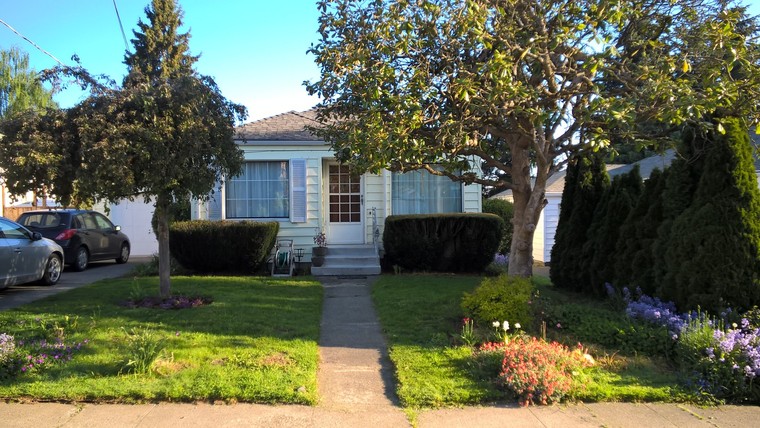




 Earlier this week, at the Windermere Builder Solutions Breakfast, more than 100 Windermere brokers came together to listen to Windermere President OB Jacobi lead a panel discussion on new home construction trends in the greater Seattle area. The panelists included Mike Owen, General Manager: Macadam Floor & Design; Belinda Leppa, Sr. Designer: Macadam Floor & Design; Curtis Gelotte, Sr. Principal: Gelotte Hommas Architecture; and Eric Drivdahl, Principal: Gelotte Hommas Architecture.