More October 25, 2010

The First Decade


The other day I was searching for my daughter’s cell phone number – which I haven’t memorized because I simply speed-dial it – and I realized it’s been years since I memorized anyone’s phone number. And this was just after I’d booked a flight online and selected my seat, and downloaded some new music into my iPod.

It occurred to me that these are just three examples of the tremendous changes that have happened just since the new millennium began. At the beginning of this decade, iTunes, YouTube and Facebook did not exist. Today, their combined daily views and downloads are in the billions.

An article in Newsweek a few months ago highlighted how much things have changed in a decade. The numbers are staggering and surprising.


  • Ten years ago, a total of 400,000 text messages were sent per day; today 4.5 billion are zinging through cyberspace every day.
  • In 2000, 12 billion emails were sent each day; today 247 billion are sent daily (many of which were in my spam filter this morning).
  • Ten years ago, about 208 billion letters were mailed through the postal system each day; today the number of letters mailed daily is less than 176 billion.

This decade has been tumultuous, to say the least. Beyond the tremendous technology-driven advances, we are still struggling with this economy. Unemployment rates are too high. Banks are still struggling. And it is heartbreaking that people have lost their homes.

Even though there is a lot of uncertainty, I remain optimistic. I am realistic enough to know that this recovery will take awhile. But recover we will.

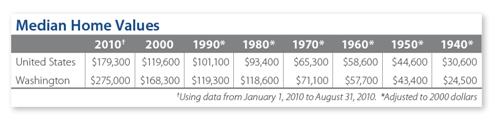
One thing that hasn’t changed in the past decade is the resiliency of real estate over time. When you look at median single-family home prices ten years ago versus this year, you’ll see that home values have increased since 2000. This is encouraging, especially when you consider that the stock market today is the same place it was 10 years ago. For most people, their home is worth more today than when they bought it. It might be worth less than it was two or three years ago, but real estate has never been about day trading. It’s a long-term investment. And if the last 10 years, or 100 years, are any indication, we can count on growth in home values.

And that’s a good thing.


July Median Home Prices*
2000


2010


National
$151,100
$182,600


*Source:  NWMLS

What are some of the most memorable changes for you in the past decade?

More October 21, 2010

Bringing comfort to families in need: Tacoma Professional Partners volunteer at Multicare Tree House

Windermere Tacoma- Professional Partners spent May 20th serving the families and volunteers at the Tacoma Multicare Tree house. Volunteers prepared a fully stocked Taco bar for families. There was so much food the Windermere team visited the nearby hospitals, Tacoma General’s Neonatal Intensive Care Unit (NICU) and the Mary Bridge’s Pediatric Intensive Care Unit (PICU) and invited families waiting to join residents for dinner at the Tree House facility. Volunteers spent the day chatting with families and providing additional support to the volunteers and residents.

Windermere Professional Partners has a long-standing history with Multicare Tree House, they are dedicated fundraisers, provide volunteer services and have sponsored a room in Wally Starkey’s memory (a former owner). The funds dedicated to Tree House through the Windermere Foundation go to support access for low income families.

Multicare Tree house provides housing for families while their children are receiving medical care at Tacoma General’s Neonatal Intensive Care Unit or Mary Bridge’s Pediatric Intensive Care Unit. The organization provides family housing, sleep rooms, bathrooms, a place to eat, phone, internet and TVs as well as a laundry facility. The work volunteers do at tree house helps families find comfort in some of their hardest hours.

In 2010 the Windermere Foundation sponsored a video contest, asking for video submissions showcasing the amazing organizations Windermere Foundation and Offices have the privilege to work with. We received 24 video submissions and selected five ‘winning’ videos in late September 2010. The Offices who submitted these videos have received a $2,000 donation to benefit their Foundation charity of choice. All the videos are too good to keep to ourselves, so over the next two months we will be sharing the videos created by Windermere Offices and highlight the great organizations they chose to work with.

Living October 21, 2010

Weatherizing your home: protecting your investment through the harsh winter months

It seems the winter is settling in early through much of the West Coast this year, with October frost and early winter warnings. Last week The Seattle Times reported, "This year will bring the most intense La Niña conditions since 1955 … Meteorologists say more rain, colder temperatures and bigger snowstorms are likely.” Whether the meteorologists are right this year or not, now is the time to do some home repair so you can enjoy the winter inside your warm house.

Weatherizing your home should be more than just packing in your patio furniture, checking your furnace and cleaning out your rain gutters, though these make a big difference in preparing your home and avoiding December disasters. Weatherizing your home–especially in light of harsh warnings–will protect your investment from preventable damage, save money on energy costs and, most importantly, keep your home safe and warm for you and your loved ones throughout the winter season. Here is a useful checklist to manage your weatherization project.

Getting started: Check your toolbox to make sure you have all the materials you need for home maintenance in one place. This NY Times article provides a good list of the tools you’ll really need to maintain your home. After your toolbox is put together, you can confidently begin the maintenance on your home.

Insulation: According to the Sustainable Energy Info Fact Sheet “Insulating a home can save 45-55% of heating and cooling energy”. For the best results, your home should be properly insulated from the ceilings to the basement. However, if insulating your complete home is not in your budget, the U.S. Department of Energy states, “one of the most cost-effective ways to make your home more comfortable year-round is to add insulation to your attic.” By starting in your attic and progressively adding insulation to other areas of your home over time, you will avoid spending a large sum of money up-front.


Cracks & Leaks: Do a run-through of your entire house for cracks and leaks, from your roof to your baseboards. Winter weather is unpredictable. Whether your area gets rain, wind or snow, cracks in your house can lead to cold drafts or leaks that cause water damage. Do-it-Yourself.com reports, “The average house, even when well-insulated, contains cracks and gaps between building materials that add up to a hole about 14 inches square. All year long, a leaky house not only wastes energy, but can lead to water damage and provide a path for insects”.  Depending on your house type, most cracks can be easily filled with supplies from your local hardware store in a do-it-yourself fashion. Use caulk to seal any cracks in the permanent building materials.


Windows & Doors: Another common place for heat leakage is in your windows and exterior doorways. Make sure seals are tight and no leaks exist. If you have storm windows, make sure you put them on before the cold season begins. This 5 minute video, How to Caulk Windows & Doors, demonstrates how to find leaks, pick the correct tools to use, and fill in the leaks. Don’t underestimate the difference some weather strips and a door sweep can provide in preventing drafts and keeping the heat in.

Rain Gutters: Clean your rain gutters of any debris. Buildup will cause gutters to freeze with ice, crack and then leak. Once you have removed the residue from the drains, test them by running hose water to make sure cracks and leaks have not already formed.


Pipes: Pipes are a number one risk in winter climates. A burst pipe can become a winter disaster in a matter of seconds. Remember to turn off your exterior water source and take in your hose. Internally, wrapping your pipes is a recommended precaution to take. This article from Insights, Natural Hazard Mitigation advises, “Vulnerable pipes that are accessible should be fitted with insulated sleeves or wrappings, the more insulation the better”.

Heating System: What is one thing gas fireplaces, wood burning stoves, and central air heating systems all have in common? They all need to be cleaned and maintained. Check and clean your indoor heating system thoroughly. This is important to avoid dangers such as house fires. If you use an old fashioned wood stove, make sure there is no leaks and that all soot build up or nests are removed. If a furnace is what you have remember to change the filters as recommended or clean out your reusable filters.

Fireplace & Wood burning stoves: Make sure to have chimneys and air vents cleaned early in the season if you are planning on warming your home with a wood-burning source. When your fireplace is not in use make sure to close the damper, some resources estimate an open damper can increase energy consumption as much as 30%.

Outside: As we mentioned before make sure you bring your patio furniture inside (or cover) for the winter- but don’t forget other, smaller items such as your tools, including a hose and small planting pot. These items can be damaged or broken in extreme cold. Clear out any piles around the side of your house, checking for cracks as you go so to avoid providing shelter for unwelcomed guests over the cold season.

If your property has large trees check for loose branches and call someone to trim back any items that may fall in your yard, on your roof or even damage a window.


Emergency Kit: Make sure your emergency kit is up-to-date with provisions, batteries, fresh water, food for animals, entertainment for kids, etc- especially if you live in an area prone to power outages.

When it comes to protecting our investments and our families’ safety “an ounce of prevention is worth a pound of cure” is a good philosophy. Your winter preparedness plan will fit your property, schedule and needs. What are some tips you have for preparing for winter? What are some of your favorite activities to do at home over the winter while weathering out a storm?

By Brittany Lockwood

You may know Brittany as the helpful voice behind the Marketing Solutions Help Desk. She grew up in Cheney, Washington so she knows a thing or two about harsh winters.

More October 15, 2010

Windermere Agents have a “get it done attitude”

In 2010 the Windermere Foundation sponsored a video contest, asking for video submissions showcasing the amazing organizations Windermere Foundation and Offices have the privilege to work with. We received 24 video submissions and selected five ‘winning’ videos in late September 2010. The Offices who submitted these videos have received a $2,000 donation to benefit their Foundation charity of choice. All the videos are too good to keep to ourselves, so over the next two months we will be sharing the videos created by Windermere Offices and highlight the great organizations they chose to work with.

In June 2010 agents from the Windermere Ballard office in Seattle responded to the need for volunteer labor to move the Ballard Food Bank to a new facility. Because of the volunteer work of many community members and groups, the Ballard Food Bank was able to upgrade and move locations at a third of the cost– preserving their financial resources to fulfill their mission and feed families and community members in need. The Windermere team helped to break down and remove debris of the storage shed at the old facility within a day.

The Ballard Food Bank is a tremendous asset to Ballard and surrounding communities serving more than 1,000 households each month with food, hygiene and financial emergency resources. In 2009 they provided more than a million pounds of food to community members.

Selling October 14, 2010

Sellers: Making the Most of your First Impressions

As the old saying goes, you only have one chance to make a first impression. If you’re selling your home, it’s true, except that there are several impressions to be made, and each one might have its own effect on the unique tastes of a prospective buyer. I’ve worked with scores of buyers, witnessed hundreds of showings, and I can summarize that experience down this: a tidy and well maintained home, priced right, listed with professional photographs, enhanced curb appeal and onsite visual appeal will sell fastest. We all know first impressions are very important, but the lasting impressions are the ones that sell your home. It’s not easy, but if you can detach a little and look at your home from a buyer’s perspective, the answers to selling it quickly may become obvious to you.

The very first impression your home will make is through its web presence, whether on Windermere.com, the MLS, Craigslist or any multitude of websites. Fair or not, the price is typically the very first thing people look at, and it will be the measurement by which your home is judged. You can always adjust to the right price later, but the impact is lost. It will take something dramatic to get a buyer to reassess the way they feel about the value of your home.

Closely following price are the listing photos. According to this recent article in the Wall Street Journal, professional photos will not only impact your first impressions, it may also make a difference in the final selling price. Great photos might even overcome those initial price objections. Does the exterior photo capture your home at its hi-res best? Does the accompanying text enhance or distract? Online, your home has only a few seconds to capture the home buyer’s attention. If it doesn’t, they’ll click the “Back” button and resume their search. The goal is to have buyers excitedly calling their agents to arrange a showing.

Another old saying is “Location, location, location,” and sure enough, the first live impression of your home is the location. Forget this one; you can’t move your home. There’s not much you can do about location, right? Actually, there is one thing you can do: price it right from the start.

Let’s move on to the first time a buyer sees your home as they pull to the curb out front. Go stand out at the curb and look at it the way you would if you were shopping for a home. Sometimes, a couple hours of labor and $100 worth of beauty bark can be worth thousands in the sales price. I’ve had buyers choose not to get out of the car when we pulled up to a home that they had once been excited to see.

Likewise, I’ve had buyers say they’ve seen enough simply by peaking into the front door. The nose trumps the eyes when it comes to the first impression when entering the house. Buyers get more caught up in the details. Once the home shopper is inside, it’s easy for them to get distracted and focus on something that seems to have nothing to do with the structure they will be buying, from a dirty dish in the sink to a teenager’s bedroom that’s been decorated in posters and/or melodrama. Do everything you can to set a positive lasting impression. The buyer may look at dozens of homes. What is your strategy to convince them to make an offer on yours?

Guest post by Eric Johnson, Director of Education
Market News October 4, 2010

Reconsidering Expectations

I was fascinated to read my associate Karl Case’s article on housing published in the New York Times a couple of weeks ago.  In it he suggests that the “American dream” of home ownership, rather than being dead in the water, is actually alive although somewhat battered!

Agents, buyers and sellers alike are currently being inundated with market “analysis” and “commentary” relative to the current and, indeed, future of our housing market in the U.S. and the disparity between the opinions is vast.  There are some who are projecting a further 20 percent decline in value and others who believe that we have bottomed out and a recovery is around the corner.  It is all immensely confusing.

So what is the likely direction of housing as we move forward with our overall economic recovery?

It is my opinion that the mass pricing declines that we saw were a function of a meltdown in the market and that we have seen the worst of the price declines.  As we move forward, the recovery in real estate will not on a national level but will be market specific, with some areas faring better than others.  I believe that markets with better employment prospects, topographic and political restrictions that limit new development and lower foreclosure activity are likely to fare better than others.  The US Census bureau shows that we live in a country with 310 million residents and over 77 million owner-occupied housing units; to suggest that a recovery will be equal across the country is naive.

The core of Case’s argument is that the “Dream” very much depends on what one’s expectations are.  If house buying is driven by the expectation of astronomical returns, then it is fair to believe that this will not be the case going forward.  However, if buyers are realistic in their expectations of value and a good rate of return, that a home represents stability, offers tax incentives, as well as managing the fundamental need for shelter, then home ownership does indeed make sense. (Historically, housing has always appreciated at a greater rate than inflation and if you believe, as I do, that inflation is certainly headed our way, it will act as a good hedge against it.)

There is an old adage that all real estate is local and I agree with this.  As we move forward, expect markets to fluctuate depending on the above criteria.  Fear mongering does nobody any good and I hope that we will see less of this occurring as data continues to point toward improving economic conditions.

BuyingLivingSelling September 21, 2010

Investing in home: building a foundation for memories


"Of course, thanks to the house, a great many of our memories are housed, and if the house is a bit elaborate, if it has a cellar and a garret, nooks and corridors, our memories have refuges that are all the more clearly delineated. All our lives we come back to them in our daydreams.”

Gaston Bachelard, the Poetics of Space


I have been following the news about the housing market pretty closely and am pretty disappointed with some of the articles declaring a case against homeownership. I couldn’t disagree more. If anything, I see the value of homeownership: responsible financial investment, social stability and community connection as more important than ever.

I was particularly moved by the story in the Seattle Times yesterday about the Lutz family in Ballard, a family with seven adopted siblings that are helping their parents move from their family home to a smaller condo now that their children have left the nest. Though their story is far from typical, it really resonates how home is the center of family life, a place where memories are created and how houses tell the stories of the lives we build while in their shelter.

Homes do that for people. They are the places where some of our most intimate stories unfold.

Finding and creating a home is an emotional, psychological, social and financial investment.  There is a lot of energy involved in finding the place to envision the future, raise a family, and perhaps retire. There is no other investment as enjoyable as your own home. Investments in gold or stocks cannot compare to the feelings about a place where you collect memories, create spaces that reflect your ideals and develop to fit your needs over time.

Beyond the emotional ties to home, a number of studies have shown that home ownership has a great impact on feelings of personal autonomy, life satisfaction and increased investment in the community. The sense of satisfaction goes beyond the ability to paint walls whatever color we want, or make improvements to our homes on our own terms. It goes deeper by improving our sense of well being. Furthermore, when we have a stake in the community we live in, we participate more, making our neighborhoods safer and healthier for all members.

Not all the news about the housing market is negative, actually there are many great articles: “in defense of home ownership”, “ten reasons to buy a home “and “a dream house after all” to name a few. But regardless of where you stand on the housing market right now, we can all likely agree that there is no place like a home.

All of our experiences of home are unique. Please share your best memories of home.

BuyingMarket NewsSelling September 17, 2010

What do you think about the recent market news?

There is no question the economy and the housing market has slowed down over the last few years and the recent deluge of articles for and against homeownership is impossible for us to ignore. Ultimately, we believe that the American dream of homeownership is alive and well. There are inherent benefits to investing in your home, for financial reasons, personal and societal benefit and the overall stability of the national economy.

We have more to say on this topic, but first, we want to know what you think. Can we provide any information to clarify the reports regarding the real estate market? What is the value you place on owning your own home? What is your advice to people entering the real estate market? If you are interested in purchasing your first home, what do you want to know?

More September 9, 2010

What is a Community?

The annual Windermere Symposium takes place at the end of the month, during which hundreds of our agents gather in person. They’ll talk about important issues, share ideas, and learn about new products and services to help them serve their clients. It’s a community in the very best sense of the word: people united by shared values, camaraderie and a common cause.

The notion of “community” has changed and expanded in recent years, thanks to the Internet. Virtual communities are a powerful phenomenon. For better or worse, cyber connections are a big part of society. Blogs, social networking sites like Facebook, Web-only companies and other e-organizations are growing at a staggering rate. Today, we can tweet, text, Skype, email, and “friend” and “unfriend” others. (I’m not sure exactly when those last two became verbs.)

We can join online communities with others who share our interests, no matter how eclectic. Whether you’re a vampire hunter, a dog trainer, or a model train collector, there’s a community for you. We can belong to these groups without actually meeting any of the other members in person – and yet we really can share our interests and actively participate in the community.

So, are we ultimately heading toward purely virtual communities where we won’t connect in person anymore? Thankfully, no. Human connections are here to stay. In fact, some of the most popular online communities serve as an efficient “first step” toward an in-person interaction. We’re very likely to start the search for a new job or a new house – or even a new spouse – online. But it’s all leading to a face-to-face connection.

So while the Windermere community gets together online regularly to talk about the state of the industry, and how current legislation and shifts in the economy can benefit our clients, I can hardly wait to see everyone in person. We’ll shake hands with new acquaintances, hug old friends, laugh, and tell stories. We’ll talk about the real estate business for sure. But more importantly, we’ll be inspired and motivated, because we are a community dedicated to helping each other and our customers.

What are some of your favorite ways to engage with your community online and off?

More September 3, 2010

Windermere Partners with Hunger Relief Organizations to Break Guinness World Record

Do you want to work with your community to relieve hunger in the Northwest? Do you want to help break the Guinness World Record for collecting the most pounds of food in a single location? Windermere is partnering with the Emergency Food Network and Northwest Harvest to collect one million pounds of food to “fill the bowl” in Tacoma, WA.

Donations of non-perishable, non-expired food will be accepted at the following Windermere offices throughout the region between Tuesday September 7th and Wednesday, September 15:

Auburn

Auburn- Lakeland Hills

Bellevue West

Bonney Lake

Gig Harbor

Gig Harbor- Down Town

Graham

Issaquah

Key Peninsula

Kirkland- Northeast

Kirkland- Yarrow Bay

Lake Forest Park

Lakeview

Mercer Island

Port Orchard

Queen Anne

Redmond

Renton

Renton- Tukwila South

Sand Point

Seattle- Capitol Hill

Shoreline

Tacoma- North

Tacoma- Central

Tacoma- Professional Partners

Tacoma- University Place


You can also drop donations on-site between 4 pm on Friday, September 17 until 4 pm on Saturday, September 18.

We will be posting the progress; you can see how we are doing by following us on facebook.

The Emergency Food Network has been working since 1982 to provide food and other essentials at no cost to over 65 food banks, hot meal sites and shelters for distribution to low-income families and individuals in Pierce County.
Northwest Harvest is Washington's own statewide hunger relief agency. Their mission is to provide nutritious food to hungry people.